Tree Man Danny Jones Make America Great Again Hat
| Daniel Boone | |
|---|---|
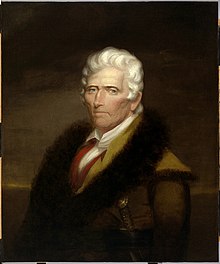 An 1820 painting by Chester Harding is the simply known portrait of Daniel Boone made during his lifetime.[1] | |
| Built-in | (1734-11-02)Nov 2, 1734 Oley Valley, Province of Pennsylvania, British America |
| Died | September 26, 1820(1820-09-26) (aged 85) Disobedience, Missouri, U.S. |
| Resting place | Frankfort Cemetery, Frankfort, Kentucky or Old Bryan Subcontract Cemetery, Marthasville, Missouri |
| Occupation |
|
| Spouse(s) | Rebecca Bryan (m. ; died ) |
| Children | 10, including Jemima, Daniel, and Nathan |
| Relatives |
|
| Signature | |
 | |
Daniel Boone (November 2, 1734 [O.S. October 22] – September 26, 1820) was an American pioneer and frontiersman whose exploits fabricated him one of the first folk heroes of the United States. Boone became famous for his exploration and settlement of what is now Kentucky, which was so beyond the western borders of the Thirteen Colonies. Despite resistance from American Indians, for whom Kentucky was a traditional hunting ground, in 1775 Boone blazed the Wilderness Road through the Cumberland Gap and into Kentucky. There he founded Boonesborough, i of the first English-speaking settlements westward of the Appalachian Mountains. By the stop of the 18th century, more than 200,000 people had entered Kentucky by following the road marked by Boone.[2]
Boone served every bit a militia officer during the Revolutionary State of war (1775–1783), which, in Kentucky, was fought primarily betwixt American settlers and British-allied American Indians. Boone was taken in past Shawnees in 1778 and adopted into the tribe, but he resigned and continued to help protect the Kentucky settlements. He was elected to the start of his three terms in the Virginia General Associates during the war, and fought in the Battle of Blue Licks in 1782, one of the final battles of the American Revolution. Boone worked every bit a surveyor and merchant after the war, just he went deep into debt as a Kentucky land speculator. Frustrated with legal problems resulting from his country claims, in 1799 Boone resettled in Missouri, where he spent about of the last ii decades of his life.
Boone remains an iconic, if imperfectly remembered, figure in American history. He was a legend in his own lifetime, especially after an account of his adventures was published in 1784, making him famous in America and Europe. After his death, Boone became the subject of many heroic tall tales and works of fiction. His adventures—real and legendary—helped create the archetypal frontier hero of American folklore. In American pop culture, Boone is remembered every bit one of the foremost early on frontiersmen, fifty-fifty though mythology often overshadows the historical details of his life.[three]
Early life [edit]
Boone was born on October 22, 1734 ("New Style" November 2), the sixth of xi children in a family of Quakers.[iv] [note 1] His father, Squire Boone (1696–1765), had emigrated to colonial Pennsylvania from the pocket-size town of Bradninch, England, in 1713. Squire, a weaver and blacksmith, married Sarah Morgan (1700–1777), whose family were Quakers from Wales. In 1731, the Boones congenital a one-room log cabin in the Oley Valley in what is now Berks County, Pennsylvania, almost present Reading, where Daniel was born.[half dozen]
Boone spent his early years on the Pennsylvania borderland, frequently interacting with American Indians.[7] Boone learned to hunt from local settlers and Indians; by the age of fifteen, he had a reputation equally 1 of the region's best hunters.[8] Many stories about Boone emphasize his hunting skills. In one tale, the young Boone was hunting in the forest with some other boys when the howl of a panther scattered all merely Boone. He calmly artsy his rifle and shot the panther through the heart just equally it leaped at him. The story may exist a folktale, ane of many that became part of Boone'south popular epitome.[8]
In Boone's youth, his family unit became a source of controversy in the local Quaker customs. In 1742, Boone's parents were compelled to publicly repent after their eldest child Sarah married a "worldling", or non-Quaker, while she was visibly pregnant. When Boone's oldest brother Israel also married a "worldling" in 1747, Squire Boone stood by his son and was therefore expelled from the Quakers, although his wife connected to attend monthly meetings with her children. Perhaps as a result of this controversy, in 1750 Squire sold his land and moved the family unit to North Carolina. Daniel Boone did not nourish church over again, although he always considered himself a Christian and had all of his children baptized.[nine] The Boones eventually settled on the Yadkin River, in what is now Davie County, Northward Carolina, about two miles (3 km) due west of Mocksville.[10] [11]
Boone received little formal education, since he preferred to spend his time hunting, manifestly with his parents' approving. According to a family tradition, when a schoolteacher expressed concern over Boone'due south education, Boone's father said, "Let the girls do the spelling and Dan volition do the shooting."[12] Boone was tutored by family unit members, though his spelling remained unorthodox. Historian John Mack Faragher cautions that the folk image of Boone every bit semiliterate is misleading, arguing that Boone "acquired a level of literacy that was the equal of most men of his times."[12] Boone regularly took reading textile with him on his hunting expeditions—the Bible and Gulliver's Travels were favorites.[13] He was often the only literate person in groups of frontiersmen, and would sometimes entertain his hunting companions past reading to them effectually the bivouac.[xiv] [15]
Hunter, husband, and soldier [edit]
I can't say equally ever I was lost, just I was bewildered one time for three days.
—Daniel Boone[16]
When the French and Indian War (1754–1763) broke out between the French, British, and their respective Indian allies, Boone joined a North Carolina militia company as a teamster and blacksmith.[17] In 1755, his unit accompanied General Edward Braddock's effort to drive the French out of the Ohio Country, which ended in disaster at the Boxing of the Monongahela. Boone, in the rear with the wagons, took no part in the boxing, and fled with the retreating soldiers.[18] Boone returned home after the defeat, and on August 14, 1756, he married Rebecca Bryan, a neighbor in the Yadkin Valley.[xix] The couple initially lived in a cabin on his father's farm, and would eventually have ten children, in add-on to raising eight children of deceased relatives.[twenty]
In 1758, disharmonize erupted between British colonists and the Cherokees, their old allies in the French and Indian War. After the Yadkin Valley was raided by Cherokees, the Boones and many other families fled n to Culpeper County, Virginia.[21] Boone saw action as a member of the North Carolina militia during this "Cherokee Uprising," periodically serving under Captain Hugh Waddell on the Northward Carolina frontier until 1760.[22]
Boone supported his growing family unit in these years as a market place hunter and trapper, collecting pelts for the fur trade. Almost every autumn, despite the unrest on the frontier, Boone would go on "long hunts", extended expeditions into the wilderness lasting weeks or months. Boone went lone or with a pocket-size group of men, accumulating hundreds of deer skins in the autumn, and trapping beaver and otter over the winter. When the long hunters returned in the spring, they sold their take to commercial fur traders.[23] On their journeys, frontiersmen oft carved messages on trees or wrote their names on cave walls, and Boone'south name or initials have been found in many places. A tree in nowadays Washington County, Tennessee, reads "D. Boon Cilled a. Bar on tree in the year 1760". A similar carving, preserved in the museum of the Filson Historical Society in Louisville, Kentucky, reads "D. Benefaction Kilt a Bar, 1803." The inscriptions may be genuine, or office of a long tradition of phony Boone relics.[24] [25] [26]
According to a popular story, Boone returned habitation afterwards a long absence to find Rebecca had given birth to a daughter. Rebecca confessed she had idea Daniel was dead, and that Boone's brother had fathered the kid. Boone did not blame Rebecca, and raised the girl equally his ain child. Boone's early on biographers knew the story but did not publish it.[27] Modern biographers regard the tale as possibly folklore, since the identity of the brother and the daughter vary in dissimilar versions of the tale.[28] [29] [xxx]
In the mid-1760s, Boone began to expect for a new place to settle. The population was growing in the Yadkin Valley, which decreased the amount of game bachelor for hunting. Boone had difficulty making ends meet; he was frequently taken to courtroom for nonpayment of debts. He sold what land he owned to pay off creditors. After his male parent's death in 1765, Boone traveled with a group of men to Florida, which had go British territory afterward the finish of the war, to expect into the possibility of settling at that place. According to a family unit story, Boone purchased land in Pensacola, only Rebecca refused to motility so far away from friends and family. The Boones instead moved to a more remote area of the Yadkin Valley, and Boone began to hunt due west into the Blue Ridge Mountains.[31]
Into Kentucky [edit]
It was the first of May, in the year 1769, that I resigned my domestic happiness for a fourth dimension, and left my family ... to wander through the wilderness of America, in quest of the country of Kentucky.
—Daniel Boone[32]
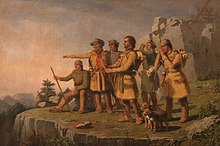

George Caleb Bingham's Daniel Boone Escorting Settlers through the Cumberland Gap (1851–52) is a famous depiction of Boone.
Years before entering Kentucky, Boone had heard about the region'southward fertile land and arable game. In 1767, Boone and his brother Squire kickoff crossed into what would get the state of Kentucky, only they failed to attain the rich hunting grounds.[33] [34] In May 1769, Boone set out once more with a party of five others, beginning a two-yr hunting expedition in which Boone thoroughly explored Kentucky. His commencement sighting of the Bluegrass region from atop Pilot Knob became "an icon of American history," and was the frequent discipline of paintings.[35]
On December 22, 1769, Boone and a fellow hunter were captured past a party of Shawnees, who confiscated all of their skins and told them to go out and never render. The Shawnees had not signed the 1768 Treaty of Fort Stanwix, in which the Iroquois had ceded their claim to Kentucky to the British. The Shawnees regarded Kentucky every bit their hunting ground; they considered American hunters there to be poachers.[36] [37] Boone, undeterred, connected hunting and exploring in Kentucky. On one occasion, he shot a man to avoid capture, which historian John Mack Faragher says "was one of the few Indians that Boone best-selling killing."[38] Boone returned to North Carolina in 1771, just came back to hunt in Kentucky in the autumn of 1772.[39]
In 1773, Boone packed upward his family unit and, with his brother, Squire, and a group of most 50 others, began the first attempt past British colonists to establish a settlement. Boone was still an obscure figure at the fourth dimension; the well-nigh prominent member of the trek was William Russell, a well-known Virginian and future blood brother-in-law of Patrick Henry.[40] Another member of this expedition was Boone's friend and fellow long-hunter, Michael Stoner.[41]
Included in this group were an unknown number of enslaved Blacks, including Charles and Adam. On Oct 9, Boone's oldest son, James, and several whites too every bit Charles and Adam left the main party to seek provisions in a nearby settlement. They were attacked past a band of Delawares, Shawnees, and Cherokees. Post-obit the Fort Stanwix treaty, American Indians in the region had been debating what exercise to nearly the influx of settlers. This grouping had decided, in the words of Faragher, "to send a message of their opposition to settlement".[42] James Boone and William Russell's son, Henry, were tortured and killed. Charles was captured. Adam witnessed the horror concealed in riverbank driftwood. After wandering In the woods for 11 days, Adam located the grouping and informed Boone of the circumstances of their deaths. Charles'due south body was institute past the pioneers twoscore miles from the abduction site, expressionless from a blow to his head.[43] [44] The brutality of the killings sent shockwaves forth the frontier, and Boone'southward party abandoned their expedition.[45]
The attack was one of the showtime events in what became known as Dunmore'due south War, a struggle between Virginia and American Indians for control of what is at present West Virginia and Kentucky. In the summer of 1774, Boone traveled with a companion to Kentucky to notify surveyors in that location most the outbreak of state of war. They journeyed more than 800 miles (ane,300 km) in 2 months to warn those who had not already fled the region. Upon his return to Virginia, Boone helped defend colonial settlements forth the Clinch River, earning a promotion to captain in the militia, as well every bit acclaim from fellow citizens. After the brief war, which ended soon later on Virginia's victory in the Boxing of Bespeak Pleasant in October 1774, the Shawnees relinquished their claims to Kentucky.[46] [47]
Following Dunmore'south War, Richard Henderson, a prominent guess from North Carolina, hired Boone to help constitute a colony to be chosen Transylvania.[annotation 2] Boone traveled to several Cherokee towns and invited them to a meeting, held at Sycamore Shoals in March 1775, where Henderson purchased the Cherokee claim to Kentucky.[49]
Boone then blazed "Boone'due south Trace," after known as the Wilderness Road, through the Cumberland Gap and into key Kentucky. Sam, an enslaved black "trunk retainer," and other enslaved laborers were among this group of settlers. When this grouping camped near the present twenty-four hours Richmond, KY, Indians attacked, killing Sam and his enslaver. Afterwards driving off the attackers, the party cached the two men side by side.[44]
He founded Boonesborough forth the Kentucky River; other settlements, notably Harrodsburg, were also established at this fourth dimension. Despite occasional Indian attacks, Boone brought his family and other settlers to Boonesborough on September 8, 1775.[l]
American Revolution [edit]
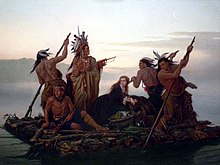
American Indians who were unhappy about the loss of Kentucky in treaties saw the American Revolutionary War (1775–1783) every bit a take chances to drive out the colonists. Isolated settlers and hunters became the frequent target of attacks, disarming many to abandon Kentucky. By belatedly leap of 1776, Boone and his family were amongst the fewer than 200 colonists who remained in Kentucky, primarily at the fortified settlements of Boonesborough, Harrodsburg, and Logan's Station.[51]
On July fourteen, 1776, Boone's daughter Jemima and 2 other girls were captured outside Boonesborough past an Indian war political party, who carried the girls north toward the Shawnee towns in the Ohio country. Boone and a group of men from Boonesborough followed in pursuit, finally catching up with them 2 days later. Boone and his men ambushed the Indians, rescuing the girls and driving off their captors. The incident became the most celebrated event of Boone'due south life. James Fenimore Cooper created a version of this episode in his classic novel The Last of the Mohicans (1826).[52] [53]
In 1777, Henry Hamilton, British Lieutenant Governor of Quebec, began to recruit American Indian war parties to raid the Kentucky settlements. That same yr in March, the newly formed militia of Kentucky Canton, VA mustered in Boonesborough, whose population included ten to 15 enslaved people. [43]On April 24, 1778, the British-allied Shawnees led by Chief Blackfish mounted the siege of Boonesborough. Armed enslaved men fought aslope their enslavers at the fort's walls. After going beyond the fort walls to appoint the attackers, London, one of the enslaved, was killed. [44]
Boone was shot in the ankle while outside the fort just, amid a flurry of bullets, he was carried back inside by Simon Kenton, a recent arrival at Boonesborough. Kenton became Boone's close friend, every bit well equally a legendary frontiersman in his ain right.[54] [55]
Capture and court-martial [edit]
While Boone recovered, Shawnees kept up their attacks outside Boonesborough, killing cattle and destroying crops. With food running low, the settlers needed salt to preserve what meat they had, then in Jan 1778, Boone led a party of xxx men to the salt springs on the Licking River. On February 7, when Boone was hunting meat for the expedition, he was captured by Blackfish's warriors. Considering Boone's party was greatly outnumbered, Boone returned to army camp the next twenty-four hour period with Blackfish and persuaded his men to surrender rather than put upward a fight.[56]
Blackfish intended to move on to Boonesborough and capture it, just Boone argued the women and children would not survive a winter trek equally prisoners back to the Shawnee villages. Instead, Boone promised that Boonesborough would surrender willingly the following bound. Boone did non have an opportunity to tell his men that he was bluffing to foreclose an immediate attack on Boonesborough. Boone pursued this strategy so assuredly some of his men concluded he had switched sides, an impression that led to his courtroom-martial (see beneath).[57] [58] Many of the Shawnees wanted to execute the prisoners in retaliation for the recent murder of Shawnee Chief Cornstalk past Virginia militiamen. Because Shawnee chiefs led by seeking consensus, Blackfish held a council. Afterwards an impassioned speech past Boone, the warriors voted to spare the prisoners.[59] [60] Although Boone had saved his men, Blackfish pointed out that Boone had not included himself in the agreement, so Boone was forced to run the gauntlet through the warriors, which he survived with minor injuries.[61] [62]
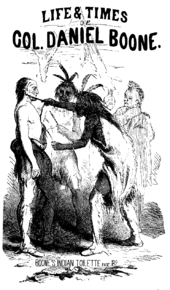
Illustration of Boone'southward ritual adoption by the Shawnees, from Life & Times of Col. Daniel Boone, by Cecil B. Hartley (1859)
Boone and his men were taken to Blackfish's town of Chillicothe. As was their custom, the Shawnees adopted some of the prisoners to replace fallen warriors. Boone was adopted into a Shawnee family unit at Chillicothe, perhaps into Blackfish'south family, and given the proper noun Sheltowee (Big Turtle).[63] [note iii] In March 1778, the Shawnees took the unadopted prisoners to Governor Hamilton in Detroit. Blackfish brought Boone along, though he refused Hamilton's offers to release Boone to the British. Hamilton gave Boone gifts, attempting to win his loyalty, while Boone continued to pretend that he intended to surrender Boonesborough.[65] Boone returned with Blackfish to Chillicothe. On June 16, 1778, when he learned Blackfish was virtually to return to Boonesborough with a large forcefulness, Boone eluded his captors and raced home, covering the 160 miles (260 km) to Boonesborough in five days on horseback and, after his horse gave out, on human foot. Biographer Robert Morgan calls Boone's escape and render "one of the groovy legends of frontier history."[66]
Upon Boone's return to Boonesborough, some of the men expressed doubts about Boone'due south loyalty, since he had apparently lived happily amidst the Shawnees for months. Boone responded past leading a preemptive raid confronting the Shawnees across the Ohio River, then by helping to successfully defend Boonesborough against a ten-day siege led by Blackfish, which began on September 7, 1778.[67] Afterwards the siege, Captain Benjamin Logan and Colonel Richard Callaway—both of whom had nephews who were all the same captives surrendered by Boone—brought charges against Boone for his recent activities. In the court-martial that followed, Boone was institute "non guilty," and was even promoted later on the courtroom heard his testimony. Despite this vindication, Boone was humiliated by the court-martial, and he rarely spoke of it.[68] [69]
Terminal years of the Revolution [edit]
Afterward the trial, Boone returned to N Carolina to bring his family back to Kentucky. In the autumn of 1779, a big party of emigrants came with him, including the family of Captain Abraham Lincoln, gramps of the hereafter president.[seventy] [71] Rather than remain in Boonesborough, Boone founded the nearby settlement of Boone'south Station. He began earning coin by locating good land for other settlers. Transylvania land claims had been invalidated after Virginia created Kentucky County, and so settlers needed to file new state claims with Virginia. In 1780, Boone nerveless about $xx,000 in greenbacks from diverse settlers and traveled to Williamsburg to purchase their land warrants. While he was sleeping in a tavern during the trip, the cash was stolen from his room. Some of the settlers forgave Boone the loss; others insisted he repay the stolen coin, which took him several years to practice.[72]
In contrast to the later folk image of Boone as a mountaineer who had little affinity for "civilized" society, Boone was a leading denizen of Kentucky at this time.[73] When Kentucky was divided into three Virginia counties in Nov 1780, Boone was promoted to lieutenant colonel in the Fayette County militia. In Apr 1781, he was elected as a representative to the Virginia Full general Associates, which was held in Richmond. In 1782, he was elected sheriff of Fayette Canton.[74]
Meanwhile, the American Revolutionary War continued. Boone joined Full general George Rogers Clark's invasion of the Ohio country in 1780, fighting in the Battle of Piqua against the Shawnee on August 7.[75] On the way domicile from the entrada, Boone was hunting with his brother Ned when Shawnees shot and killed Ned, who resembled Daniel. The Shawnees beheaded Ned, believing him to be Daniel, and took the head as evidence that Daniel Boone had finally been slain.[76] [note 4]
In 1781, Boone traveled to Richmond to have his seat in the legislature, just British dragoons under Banastre Tarleton captured Boone and several other legislators near Charlottesville. The British released Boone on parole several days later.[78] [79] During Boone'southward term, Cornwallis surrendered at Yorktown in Oct 1781, merely the fighting continued in Kentucky. Boone returned to Kentucky and in August 1782 fought in the Battle of Blue Licks, a disastrous defeat for the Kentuckians in which Boone's son Israel was killed. In November 1782, Boone took part in another Clark-led expedition into Ohio, the terminal major campaign of the war.[fourscore] [81]
Man of affairs and political leader [edit]
| Daniel Boone | |
|---|---|
| | |
| Lieutenant Colonel of the Fayette County, Virginia Militia | |
| In role November 1780 – September 1786 | |
| Consul to the Virginia General Assembly for Fayette County, Virginia | |
| In office Oct 1781[82] – Dec 1781 | |
| In office October 1787 – December 1787 | |
| In role October 1791 – December 1791 | |
| Sheriff, of Fayette County, Virginia | |
| In office June 25, 1782[83] – unknown | |
| Lieutenant Colonel of Kanawha County Virginia Militia | |
| In part October 1789 – December 1795 | |
| Delegate to the Virginia General Associates for Kanawha County, Virginia | |
| In office October 1791 – Dec 1791 | |
| Syndic and commandant of the Femme Osage District | |
| In office 1799–1804 | |
| County coroner and deputy surveyor of Fayette County, Virginia | |
| In part Unknown, c. 1780s – Unknown, c. 1780s | |
After the Revolutionary State of war ended, Boone resettled in Limestone (later renamed Maysville, Kentucky), and then a booming Ohio River port. He kept a tavern and worked every bit a surveyor, horse trader, and land speculator. In 1784, on Boone'south 50th altogether, frontier historian John Filson published The Discovery, Settlement and Present State of Kentucke. The pop book included a chronicle of Boone's adventures, which made Boone a celebrity.[84] [85]
Equally settlers poured into Kentucky, the border war with American Indians north of the Ohio River resumed. In September 1786, Boone took part in a military expedition into the Ohio Country led past Benjamin Logan. Returning to Limestone, Boone housed and fed Shawnees who were captured during the raid, and helped to negotiate a truce and prisoner exchange. Although the war would not finish until the American victory at the Battle of Fallen Timbers 8 years after, the 1786 expedition was the terminal fourth dimension Boone saw military action.[86] [note 5]
Boone was initially prosperous in Limestone, owning seven slaves, a relatively large number for Kentucky at the fourth dimension.[88] In 1786, he purchased a Pennsylvania enslaved adult female, age of most twenty, for "Xc poundes Electric current Lawfull (sic) money.".[44] A leader, he served as militia colonel, sheriff, and county coroner.[89] In 1787, he was over again elected to the Virginia state associates, this fourth dimension from Bourbon County.[ninety] He began to take financial troubles later on engaging in state speculation, buying and selling claims to tens of thousands of acres. These ventures ultimately failed because of the chaotic nature of land speculation in frontier Kentucky and Boone'due south poor business instincts.[91] Frustrated with the legal hassles that went with state speculation, in 1789 Boone moved upriver to Point Pleasant, Virginia (now West Virginia). There he operated a trading mail service and occasionally worked as a surveyor'due south banana. That same year, when Virginia created Kanawha County, Boone became the lieutenant colonel of the county militia.[92] In 1791, he was elected to the Virginia legislature for the third fourth dimension. He contracted to provide supplies for the Kanawha militia, but his debts prevented him from buying goods on credit, and so he closed his store and returned to hunting and trapping,[93] though he was frequently hampered by rheumatism.[94]
In 1795, Boone and his married woman moved back to Kentucky, on land owned by their son Daniel Morgan Boone in what became Nicholas County. The next year, Boone applied to Isaac Shelby, the first governor of the new land of Kentucky, for a contract to widen the Wilderness Route into a wagon road, but the contract was awarded to someone else.[95] [96] Meanwhile, lawsuits over conflicting land claims continued to brand their way through the Kentucky courts. Boone's remaining land claims were sold off to pay legal fees and taxes, simply he no longer paid attention to the procedure. In 1798, a warrant was issued for Boone's arrest after he ignored a summons to testify in a court example, although the sheriff never constitute him.[97] That same year, the Kentucky assembly named Boone County in his honor.[98]
Into Missouri [edit]

This engraving by Alonzo Chappel (circa 1861) depicts an elderly Boone hunting in Missouri.

Having endured legal and financial setbacks, Boone sought to make a fresh kickoff by leaving the United States.[98] In 1799, he moved his extended family to what is at present St. Charles Canton, Missouri, but was then part of Spanish Louisiana.[99] The Spanish, eager to promote settlement in the sparsely populated region, did not enforce the official requirement that all immigrants be Catholic. The Spanish governor appointed Boone "syndic" (judge and jury) and commandant (military machine leader) of the Femme Osage district.[100] Anecdotes of Boone'south tenure as syndic suggest he sought to return fair judgments rather than strictly observe the letter of the police.[101] [102]
Boone served as syndic and commandant until 1804, when Missouri became part of the United States following the Louisiana Purchase. He was appointed captain of the local militia.[103] Because Boone's land grants from the Spanish government had been largely based on oral agreements, he once more lost his land claims. In 1809, he petitioned Congress to restore his Spanish land claims, which was finally washed in 1814. Boone sold nearly of this land to repay old Kentucky debts. When the War of 1812 came to Missouri, Boone's sons Daniel Morgan Boone and Nathan Boone took part, but by that time Boone was much too onetime for militia duty.[104]
Although Boone reportedly vowed never to render to Kentucky later on moving to Missouri, stories (peradventure folk tales) were told of him making one terminal visit to Kentucky to pay off his creditors.[105] American painter John James Audubon claimed to have gone hunting with Boone in Kentucky around 1810. Years later on, Audubon painted a portrait of Boone, supposedly from retentiveness, although skeptics noted the similarity of his painting to the well-known portraits by Chester Harding.[106] [107] Some historians believe Boone visited his brother Squire near Kentucky in 1810 and have accustomed the veracity of Audubon's account.[108] [109] [note 6]
Boone spent his final years in Missouri, frequently in the visitor of children and grandchildren. He continued to chase and trap as much equally his health and energy levels permitted, intruding upon the territory of the Osage tribe, who once captured him and confiscated his furs.[111] In 1810, at the age of 76, he went with a group on a vi-month hunt up the Missouri River, reportedly every bit far as the Yellowstone River, a round trip of more than 2,000 miles.[112] [113] He began one of his final trapping expeditions in 1815, in the company of a Shawnee and Derry Coburn, a slave who was ofttimes with Boone in his terminal years.[114] They reached Fort Osage in 1816, where an officer wrote, "We have been honored past a visit from Col. Boone... He has taken part in all the wars of America, from Braddock'south war to the present hour," but "he prefers the woods, where you run into him in the dress of the roughest, poorest hunter."[115]
Death and burial [edit]
Boone died on September 26, 1820, at his son Nathan Boone'due south dwelling house on Femme Osage Creek, Missouri. He was buried next to Rebecca, who had died on March eighteen, 1813. The graves, which were unmarked until the mid-1830s, were most Jemima (Boone) Callaway'south home on Tuque Creek, well-nigh 2 miles (3 km) from nowadays-mean solar day Marthasville, Missouri.
In 1845, the Boones' remains were disinterred and reburied in a new cemetery in Frankfort, Kentucky. Resentment in Missouri nigh the disinterment grew over the years, and a legend arose that Boone'south remains never left Missouri. According to this story, Boone's tombstone in Missouri had been inadvertently placed over the incorrect grave, only no one had corrected the error. Boone'south Missouri relatives, displeased with the Kentuckians who came to exhume Boone, kept repose near the fault and immune the Kentuckians to dig up the wrong remains. No contemporary evidence indicates this really happened, simply in 1983, a forensic anthropologist examined a rough plaster bandage of Boone'due south skull made before the Kentucky reburial and announced information technology might be the skull of an African American. Black slaves were also buried at Tuque Creek, and then it is possible that the incorrect remains were mistakenly removed from the crowded graveyard. Both the Frankfort Cemetery in Kentucky and the Old Bryan Farm graveyard in Missouri claim to have Boone's remains.[116] [117]
Legacy [edit]
Many heroic actions and chivalrous adventures are related of me which exist only in the regions of fancy. With me the world has taken slap-up liberties, and yet I take been simply a common man.
—Daniel Boone[118]
Daniel Boone remains an iconic figure in American history, although his condition as an early on American folk hero and subsequently as a subject of fiction has tended to obscure the actual details of his life. He emerged as a fable in large office because of John Filson's "The Adventures of Colonel Daniel Boon", part of his book The Discovery, Settlement and nowadays State of Kentucke. First published in 1784, Filson's book was primarily intended to popularize Kentucky to immigrants.[119] It was translated into French and German, and fabricated Boone famous in America and Europe. Based on interviews with Boone, Filson'southward book contained a mostly factual account of Boone'south adventures from the exploration of Kentucky through the American Revolution, although many have doubted if the florid, philosophical dialogue attributed to Boone was authentic.[annotation 7] Oft reprinted, Filson'southward book established Boone every bit one of the first popular heroes of the United states of america.[121] [122]
Timothy Flintstone also interviewed Boone, and his Biographical Memoir of Daniel Boone, the First Settler of Kentucky (1833) became i of the best-selling biographies of the 19th century. Flint embellished Boone'due south adventures, doing for Boone what Parson Weems did for George Washington. In Flintstone'due south book, Boone fought with a bear, escaped from Indians past swinging on vines (as Tarzan would subsequently do), and and so on. Although Boone's family thought the volume was absurd, Flintstone greatly influenced the popular conception of Boone, since these tall tales were recycled in countless dime novels and books aimed at young boys.[123]
Symbol and stereotype [edit]

Thanks to Filson'southward book, Boone became a symbol of the "natural man" who lives a virtuous, uncomplicated being in the wilderness. This was famously expressed in Lord Byron's epic poem Don Juan (1822), which devoted a number of stanzas to Boone, including this 1:
Of the great names which in our faces stare,
The General Boon, back-woodsman of Kentucky,
Was happiest among mortals any where;
For killing null but a bear or cadet, he
Enjoyed the solitary vigorous, harmless days
Of his old historic period in wilds of deepest maze.[124]
Byron's poem historic Boone every bit someone who found happiness by turning his back on civilization. In a similar vein, many folk tales depicted Boone as a man who migrated to more remote areas whenever culture crowded in on him. In a typical chestnut, when asked why he was moving to Missouri, Boone supposedly replied, "I desire more elbow room!" Boone rejected this interpretation. "Nothing embitters my old age," he said late in life, like "the circulation of absurd stories that I retire as culture advances."[125]
Existing simultaneously with the image of Boone equally a refugee from guild was, paradoxically, the pop portrayal of him as civilisation'due south trailblazer. Boone was celebrated as an amanuensis of Manifest Destiny, a pathfinder who tamed the wilderness, paving the way for the extension of American civilization. In 1852, critic Henry Tuckerman dubbed Boone "the Columbus of the woods," comparing Boone's passage through the Cumberland Gap to Christopher Columbus'south voyage to the New Globe. In popular mythology, Boone became the kickoff to explore and settle Kentucky, opening the fashion for countless others to follow.[126] In fact, other Americans had explored Kentucky before Boone, as debunkers in the 20th century often pointed out, but Boone came to symbolize them all, making him what historian Michael Lofaro called "the founding father of westward expansion."[127]
In the 19th century, when Native Americans were being displaced from their lands and confined on reservations, Boone's paradigm was often reshaped into the stereotype of the belligerent, Indian-hating frontiersman which was then popular. In John A. McClung'southward Sketches of Western Take a chance (1832), for example, Boone was portrayed as longing for the "thrilling excitement of savage warfare." Boone was transformed in the popular imagination into someone who regarded Indians with contempt and had killed scores of the "savages." The real Boone disliked bloodshed. Co-ordinate to historian John Bakeless, at that place is no record that Boone ever scalped Indians, unlike other frontiersmen of the era.[128] Boone once told his son Nathan that he was certain of having killed simply one Indian, during the battle at Blue Licks,[129] although on another occasion he said, "I never killed but three."[130] He expressed regret over the killings, saying the Indians "have e'er been kinder to me than the whites."[131] Even though Boone had lost two sons and a brother in wars with Indians, he respected Indians and was respected by them. In Missouri, Boone went hunting with the Shawnees who had captured and adopted him decades before.[132] [133] Some 19th-century writers regarded Boone'southward sympathy for Indians as a graphic symbol flaw and altered his words to conform to contemporary attitudes.[134]
The grapheme John Boone in Kim Stanley Robinson's Mars trilogy is inspired past Daniel Boone. In the story, John Boone is an American astronaut, the first human to walk on Mars in the twelvemonth 2020. John Boone is ane of the "Commencement Hundred" colonists sent to permanently colonize Mars. His accomplishments and natural charm yield him an informal leadership office. After being assassinated, his larger-than-life persona plays a legendary role in the culture of colonized Mars.
Commemoration and portrayals [edit]
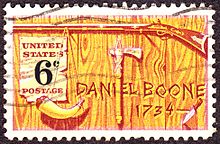
1968 Boone commemorative postage stamp
Many places in the Us are named for Boone, including the Daniel Boone National Forest in Kentucky and the Sheltowee Trace Trail in Tennessee. His name has long been synonymous with the American outdoors. The Boone and Crockett Order is a conservationist organization founded past Theodore Roosevelt in 1887, and the Sons of Daniel Boone was the precursor of the Boy Scouts of America. A half-dollar money was minted in 1934 to mark the bicentennial of Boone's birth; a commemorative stamp was issued in 1968.[135]
Boone's adventures, real and mythical, formed the basis of the archetypal hero of the American West, popular in 19th-century novels and 20th-century films. The main grapheme of James Fenimore Cooper's Leatherstocking Tales, the starting time of which was published in 1823, diameter striking similarities to Boone; fifty-fifty his name, Nathaniel Bumppo, echoed Daniel Boone's name. As mentioned in a higher place, The Last of the Mohicans (1826), Cooper'southward second Leatherstocking novel, featured a fictionalized version of Boone'due south rescue of his daughter. Later Cooper, other writers developed the Western hero, an iconic figure which began as a variation of Daniel Boone.[136]
In the 20th century, Boone was featured in numerous comic strips, radio programs, novels, and films, such equally the 1936 pic Daniel Boone. [137] Boone was the field of study of a Tv series that ran from 1964 to 1970. In the theme song for the series, Boone was described as a "big homo" in a "coonskin cap," and the "rippin'est, roarin'est, fightin'est human the frontier ever knew!"[notation viii] This did not describe the real Boone, who was not a large man and did not wear a coonskin cap, which he thought uncouth and uncomfortable.[138] Boone was portrayed this way in the Idiot box serial because Fess Parker, the tall role player who played him, was essentially reprising his role every bit Davy Crockett from an earlier Goggle box serial. That Boone could exist portrayed the same way as Crockett, some other American frontiersman with a very dissimilar personality, was another example of how Boone's image was reshaped to suit popular tastes.[122] [139] He was besides the subject matter for the vocal sung by Ed Ames chosen "Daniel Boone". It was released in 1966.
In Blood and Treasure, released in 2021, authors Tom Clavin and Bob Drury painted a much broader historical portrait of Boone than has been commonly described.[140]
The Taking of Jemima Boone by Matthew Pearl, published in 2021, is an account of the abduction of the daughter of Daniel Boone and, after her rescue by Boone, then shifts to the conflicts between Boone, his political rival Richard Callaway, and Shawnee leader Blackfish, with resulting impacts to the Western theater of the American Revolutionary War.[141]
Boone was the footing and inspiration for the 2022 contained picture Boone: The Vengeance Trail, written, directed by, and starring Jake C. Immature. The movie follows Daniel, a widowed conservation officeholder, who sets out to discover his daughter when she is abducted past his wife's murderer. The film was also produced by frequent Young collaborators, Rajiim A. Gross and Kenny Scott Guffey.
See also [edit]
- Edward Morgan Log Firm
- Daniel Boone Homestead
- Daniel Boone School
- Thomas S. Hinde, close friend of the Boone Family unit, neighbour in Kentucky, and interviewer of Boone
- Boone's Cave Park
- Daniel Boone National Forest
- Boone Trail, between Virginia Embankment, Virginia and San Francisco, California
References [edit]
Notes [edit]
- ^ The Gregorian agenda was adopted during Boone's lifetime, which moved his birth date from October 22 to November two; Boone e'er used the October engagement.[five]
- ^ Boone's earlier expeditions into Kentucky might have been financed by Henderson in exchange for data about potential places for settlement, though the record is unclear.[48]
- ^ Biographers commonly state that Boone was adopted past Blackfish, but historian John Sugden believes Boone was probably adopted by another family.[64]
- ^ Morgan says Ned Boone was probably just scalped, not beheaded.[77]
- ^ Virtually biographers tell a story of Boone allowing his friend Blue Jacket, a Shawnee principal, to escape while in Boone'southward custody in Limestone. According to the scholarly biography of Bluish Jacket, the primary escaped at a later time.[87]
- ^ Morgan surmises that Audubon probably met Boone in Missouri but claimed the encounter had been in Kentucky because of Boone's famed connection to that state.[110]
- ^ Different most biographers, Morgan argues the dialogue in Filson's book may exist a adequately accurate representation of how Boone would have spoken to an educated easterner like Filson.[120]
- ^ The consummate lyrics of the song: Archived June 20, 2006, at the Wayback Machine.
Citations [edit]
- ^ Faragher 1992, p. 317.
- ^ Faragher 1992, p. 351.
- ^ Lofaro 2012, pp. 180–83.
- ^ Morgan 2007, p. 9.
- ^ Bakeless 1939, p. 7.
- ^ Faragher 1992, p. 10.
- ^ Faragher 1992, pp. 17–18.
- ^ a b Faragher 1992, p. 9.
- ^ Faragher 1992, p. 311.
- ^ Faragher 1992, pp. 25–27.
- ^ Bakeless 1939, pp. 16–17.
- ^ a b Faragher 1992, p. 16.
- ^ Faragher 1992, pp. 55–56.
- ^ Faragher 1992, p. 17.
- ^ Faragher 1992, p. 83.
- ^ Faragher 1992, p. 65.
- ^ Morgan 2007, p. 43.
- ^ Morgan 2007, p. 45.
- ^ Morgan 2007, pp. 48–51.
- ^ Morgan 2007, p. 52.
- ^ Morgan 2007, p. 60.
- ^ Morgan 2007, pp. 58–61.
- ^ Bakeless 1939, pp. 38–39.
- ^ Faragher 1992, pp. 57–58.
- ^ Lofaro 2012, p. 181.
- ^ Draper 1998, pp. 163, 286.
- ^ Faragher 1992, pp. 59.
- ^ Morgan 2007, pp. 73–77.
- ^ Faragher 1992, pp. 58–61.
- ^ Brownish 2008, pp. 25–26.
- ^ Faragher 1992, pp. 62–66.
- ^ Morgan 2007, p. 339.
- ^ Faragher 1992, p. 71.
- ^ Morgan 2007, p. 85.
- ^ Morgan 2007, p. 97.
- ^ Faragher 1992, pp. 79–80.
- ^ Aron 1996, pp. 18–19.
- ^ Faragher 1992, p. 86.
- ^ Faragher 1992, pp. 87–88.
- ^ Faragher 1992, p. xc.
- ^ "Michael Stoner: The Frontiersman Who Was Always In that location". www.varsitytutors.com . Retrieved November 2, 2021.
- ^ Faragher 1992, p. 93.
- ^ a b Lucas, Marion B. (1997). "African Americans on the Kentucky Frontier". The Register of the Kentucky Historical Society. 95 (ii): 121–134. JSTOR 23383743.
- ^ a b c d Lucas, Marion Brunson (2003). A history of Blacks in Kentucky : from slavery to segregation, 1760-1891. Frankfort: Kentucky Historial Society. pp. 11, XII, 84. ISBN978-0-8131-5977-5. OCLC 1007290645.
- ^ Faragher 1992, pp. 89–96.
- ^ Faragher 1992, pp. 98–106.
- ^ Lofaro 2012, pp. 44–49.
- ^ Faragher 1992, pp. 74–76, 348.
- ^ Morgan 2007, pp. 156–62.
- ^ Morgan 2007, p. 189.
- ^ Faragher 1992, p. 130.
- ^ Faragher 1992, p. 331.
- ^ Bakeless 1939, p. 139.
- ^ Faragher 1992, pp. 144–47.
- ^ Morgan 2007, pp. 219–20.
- ^ Faragher 1992, pp. 154–59.
- ^ Bakeless 1939, p. 167.
- ^ Faragher 1992, pp. 156–57.
- ^ Morgan 2007, pp. 226–30.
- ^ Faragher 1992, pp. 159–60.
- ^ Faragher 1992, pp. 160–61.
- ^ Morgan 2007, p. 231.
- ^ Morgan 2007, p. 237.
- ^ Sugden 1999, p. 873.
- ^ Morgan 2007, pp. 238–41.
- ^ Morgan 2007, p. 249.
- ^ Morgan 2007, pp. 251–73.
- ^ Faragher 1992, pp. 199–202.
- ^ Lofaro 2012, pp. 105–106.
- ^ Morgan 2007, p. 284.
- ^ Faragher 1992, p. 203.
- ^ Faragher 1992, p. 208.
- ^ Faragher 1992, p. 206.
- ^ Faragher 1992, pp. 208–09.
- ^ Morgan 2007, p. 298.
- ^ Faragher 1992, pp. 211–12.
- ^ Morgan 2007, pp. 301–02.
- ^ Faragher 1992, p. 213.
- ^ Morgan 2007, pp. 302–03.
- ^ Morgan 2007, pp. 331–32.
- ^ Faragher 1992, p. 224.
- ^ Jr, Harry Kollatz (Jan 10, 2013). "Daniel Boone in the General Assembly". richmondmagazine.com . Retrieved March 11, 2021.
- ^ "SourceNotes". sourcenotes.miamioh.edu . Retrieved March eleven, 2021.
- ^ Faragher 1992, p. 236.
- ^ Morgan 2007, p. 344.
- ^ Faragher 1992, pp. 249–58.
- ^ Sugden 2000, p. 82.
- ^ Faragher 1992, pp. 236–37.
- ^ Morgan 2007, p. 349.
- ^ Morgan 2007, p. 366.
- ^ Faragher 1992, pp. 245–48.
- ^ Faragher 1992, p. 266.
- ^ Faragher 1992, pp. 268–70.
- ^ Chocolate-brown 2008, p. 222.
- ^ Faragher 1992, pp. 272–73.
- ^ Brown 2008, p. 224.
- ^ Faragher 1992, p. 273.
- ^ a b Faragher 1992, p. 274.
- ^ Faragher 1992, pp. 274–78.
- ^ Faragher 1992, p. 279.
- ^ Faragher 1992, pp. 285–86.
- ^ Chocolate-brown 2008, p. 238.
- ^ Dark-brown 2008, p. 239.
- ^ Faragher 1992, pp. 304–05.
- ^ Faragher 1992, pp. 307–09.
- ^ Jones 2005, p. 222.
- ^ Faragher 1992, p. 308.
- ^ Lofaro 2012, pp. 161–66.
- ^ Bakeless 1939, pp. 398–99.
- ^ Morgan 2007, pp. 420–21.
- ^ Brown 2008, pp. 240–42.
- ^ Faragher 1992, p. 295.
- ^ Morgan 2007, pp. 418–19.
- ^ Faragher 1992, pp. 283, 314.
- ^ Faragher 1992, p. 314.
- ^ Faragher 1992, pp. 354–62.
- ^ Jones 2005, pp. 227–thirty.
- ^ Faragher 1992, p. 302.
- ^ Slotkin 1973, pp. 268–312.
- ^ Morgan 2007, p. 336.
- ^ Faragher 1992, pp. 4–7.
- ^ a b Lofaro 2012, p. 180.
- ^ Faragher 1992, pp. 323–24.
- ^ Faragher 1992, p. 328.
- ^ Faragher 1992, pp. 302, 325–26.
- ^ Faragher 1992, pp. 321–22, 350–52.
- ^ Lofaro 2012, pp. 181–82.
- ^ Bakeless 1939, p. 162.
- ^ Faragher 1992, p. 219.
- ^ Faragher 1992, p. 39.
- ^ Morgan 2007, p. 2.
- ^ Morgan 2007, p. 245.
- ^ Faragher 1992, pp. 313–14.
- ^ Faragher 1992, pp. 320, 333.
- ^ Draper 1998, pp. xxiv–xxv.
- ^ Faragher 1992, pp. 330–33.
- ^ Faragher 1992, pp. 338–40.
- ^ Morgan 2007, p. eleven.
- ^ Faragher 1992, p. 339.
- ^ Blood and Treasure: Daniel Boone and the Fight for America's First Frontier, Publishers Weekly, January 12. 2021. Retrieved May sixteen, 2021.
- ^ What the Kidnapping of Daniel Boone's Daughter Tells Us About Life on the Frontier, New York Times, October 5, 2021. Retrieved January 6, 2022.
Sources [edit]
- Aron, Stephen (1996). How the West Was Lost: The Transformation of Kentucky from Daniel Boone to Henry Clay. Baltimore: Johns Hopkins University Press. ISBN0-8018-5296-Ten.
- Bakeless, John (1939). Daniel Boone: Primary of the Wilderness (1989 reprint ed.). Lincoln: University of Nebraska Press. ISBN0-8032-6090-3. The definitive Boone biography of its era, the commencement to fill utilise of the immense material collected by Lyman Draper.
- Brown, Meredith Mason (2008). Frontiersman: Daniel Boone and the Making of America. Baton Rouge, LA: Louisiana State University Press. ISBN978-0-8071-3356-9.
- Draper, Lyman (1998). Ted Franklin Belue (ed.). The Life of Daniel Boone. Mechanicsburg, PA: Stackpole Books. ISBN0-8117-0979-five. Belue's notes provide a modern scholarly perspective to Draper's unfinished 19th century biography.
- Elliott, Lawrence (1976). The Long Hunter: A New Life of Daniel Boone. New York: Reader'due south Digest Press. ISBN0-88349-066-8.
- Faragher, John Mack (1992). Daniel Boone: The Life and Legend of an American Pioneer. New York: Holt. ISBN0-8050-1603-1.
- Jones, Randell (2005). In the Footsteps of Daniel Boone. Winston-Salem, Due north Carolina: Blair. ISBN0-89587-308-7. Guide to historical sites associated with Boone.
- Lofaro, Michael (2012). Daniel Boone: An American Life. Lexington: University Press of Kentucky. ISBN978-0-8131-3462-8.
- Morgan, Robert (2007). Boone: A Biography. Chapel Hill, Due north.C.: Algonquin Books of Chapel Loma. ISBN978-one-56512-455-four.
- Slotkin, Richard (1973). Regeneration through Violence: The Mythology of the American Frontier, 1600–1860. Middletown, Conn.: Wesleyan University Press. ISBN0-8195-4055-ii.
- Sugden, John (1999). "Blackfish". American National Biography. Oxford Academy Press. ISBN9780195127812.
- Sugden, John (2000). Blue Jacket: Warrior of the Shawnees. Lincoln: University of Nebraska Press. ISBN0-8032-4288-iii.
Farther reading [edit]
- Filson, John. The Discovery, Settlement and present State of Kentucke, including the "Appendix" life of Boone
- Hammon, Neal O., ed. My Father, Daniel Boone: The Draper Interviews with Nathan Boone. Lexington: University Printing of Kentucky, 1999. ISBN 0-8131-2103-5.
- Reid, Darren R., ed. Daniel Boone and Others on the Kentucky Frontier: Autobiographies and Narratives, 1769–1795. Jefferson: McFarland and Company, 2009. ISBN 978-0-7864-4377-ii.
- Personal papers of Daniel Boone at the Wisconsin Historical Society searchable 32-volume collection of Boone manuscripts and correspondence, office of the Lyman Draper drove
- Works by or about Daniel Boone at Net Annal
Source: https://en.wikipedia.org/wiki/Daniel_Boone
0 Response to "Tree Man Danny Jones Make America Great Again Hat"
Post a Comment