what percentage of native american to be considered native american
Every day, I receive e-mails very similar to this one.
"My family has always said that we were function Native American. I want to bear witness this so that I can receive help with money for higher."
The reasons vary, and not everyone wants to bear witness their heritage in social club to authorize for some blazon of aid. Some want to find their tribe and bring together to reclaim their lost heritage. Some want to honor their persecuted and hidden ancestors, undoing some of the wickedness of the past, and some only seek the truth. Regardless of why, they are all searching for information lost to them.
I'd like to talk well-nigh three topics in proving Native Ancestry. First, I'd like to practice some myth-busting. Second, I'd like to talk a lilliputian nigh conventional inquiry and third, I'd similar to discuss what DNA can, and tin't, practice for you.
As you read this blog, please click on the links. I'm not going to repeat something I've already covered elsewhere.
Myth-Busting
Myth 1 – Free College
There is no gratis college for Native Americans. At that place are sometimes scholarships and grants available, generally by the individual tribes themselves, for their official members.
Myth 2 – Joining a Tribe
Many people think that if they can only effigy out which tribe their antecedent descends from, they tin join. This is untrue. Each tribe is a sovereign nation, and they get to determine their criteria for membership. Most tribes crave a specific per centum of Native "blood," called claret quantum, in addition to being able to certificate which tribal member you descend from. Some tribes require as much as 25% Native heritage, and most require at least 1/xvith Native heritage, which is one great-not bad grandparent. If you don't know who in your family was a tribal fellow member it's unlikely that you would be able to encounter the blood quantum requirement.
Myth 3 – Dna Testing Will Reveal my Tribe
Generally, DNA testing does not provide united states with the information needed to make up one's mind a tribe, although it tin clearly tell, using y-line or mitochondrial Dna testing, whether your direct paternal or maternal line was or was non Native. Sometimes you volition be able to infer a tribe based on your matches and their documented history, but the definition of tribes, their names and locations have changed over time. We are working on improving this ability, merely the scientific discipline simply isn't there however and the number of Native people who accept tested remains modest.
Simply put, most federally recognized tribes aren't interested in more tribal members. More members mean a smaller slice of the pie for existing members. The pot of resources, whatever resource you're discussing, is only so large and it must be shared past all tribal members.
What is a Tribe?
Tribes in the Usa autumn into two categories. When nigh people think well-nigh tribes they are talking about federally recognized tribes. Those are tribes that have some continuity with the past, such as they have always been a tribe, or they all the same retain tribal lands, etc., and the federal government recognizes them as such. These are the tribes that authorize for government programs and many own casinos. Equally you might imagine, with the influx of casino money, the desire to join a tribe has increased significantly.
The 2nd category is non-federally recognized tribes. Some are state recognized and others, not at all. State recognition does not in whatever way guarantee federal or state funding and there are no universal standards for state recognition. In other words, your mileage may vary, widely. Non-federally recognized tribes are often run as not-profit entities. In many cases, these tribes will help people enquiry and document their genealogy and may be more than open to tribal membership for those connecting with their Native heritage.
Be aware that some "tribes" that fall into the non-federally recognized category may exist less than ethical. Some tend to come and go. In one case, to utilise to bring together, one had to provide data such every bit social security numbers and a complete family pedigree including your children. In some cases, membership is very expensive, hundreds of dollars, but is available to nearly anyone for the right price. When evaluating tribes that are not federally recognized, if something sounds fishy, information technology probably is. Caution is the watchword.
In general, the federally recognized tribes exercise not feel kindly towards the not-federally recognized tribes and view them as "fake," interlopers trying to go function of that pie. Of course, the non-federally recognized tribes experience differently; that they are reclaiming their heritage denied them. Native American politics is nothing new and is fraught with landmines.
No federally recognized tribes, to the best of my knowledge, have considered Dna testing equally a criteria for membership. No federally recognized tribe has endorsed or participated in Dna testing that I'yard enlightened of. This does not mean that individuals have not privately tested.
Traditional Genealogy Research
Given the criteria for membership in federally recognized tribes, traditional genealogy is the just way to obtain the type of information required. If your family unit history includes a tribal proper name, and eastward of the Mississippi, that most often is Cherokee, contact the various Cherokee tribes to inquire nigh membership criteria. If the membership criteria is 25% blood breakthrough, and you must live on the reservation, you're toast…..no need to go along that line of research if your goal is to bring together the tribe.
If your goal is simply to find your Native ancestor, that's another affair entirely. Begin by using the traditional research tools.
First, look at where your ancestor or that family line was located. Did they drift from elsewhere? How were they listed in the census? Was someone listed every bit other than white, indicating mixed race? Check the records where they lived, tax records and others to see if there is any indication of non-European heritage. Call up that your non-white antecedent would accept retained their "darker" countenance for at least 2 generations later being admixed. Many Native people were admixed very early.
So first, bank check the normal genealogy records and look for hints and traces of not-European beginnings.
Second, turn to Native resources that might reflect the Native people in the areas where your family is or was found. The Access Genealogy site is absolutely wonderful and has an amazingly complete set up of records including searchable tribal rolls. In addition, I add information almost daily to the Native Heritage Projection at www.nativeheritageproject.com, which is searchable. In that location are many more resources including several collections at Ancestry.com.
Hopefully, these records volition assist narrow your focus in your family unit tree to a particular person or two, not simply a general branch. Family unit rumors like "Grandma was a Cherokee Princess" are peculiarly unuseful. What they more than likely mean is that in that location was indeed some Native beginnings someplace in her line. Cherokee has become a generic word like Kleenex. It may also have meant that Indian heritage was claimed to cover much less desirable African heritage. Institutionalized discrimination existed against any people of colour in pre-1967 America, but Indians by and large retained some rights that people of African ancestry did not. Laws varied past land and time. Take a await at my blog about Anti-Miscegenation Laws and when they were overturned.
Now, let's await at Deoxyribonucleic acid testing to see what it can do for you.
Deoxyribonucleic acid Testing to Prove Native Ancestry
There are iii types of Deoxyribonucleic acid testing that y'all tin can do to show Native Ancestry. Two are very focused on specific family lines, and 1 is much more general.
- Mitochondrial for your directly maternal line.
- Y-line for your direct paternal line – if you are a male person. Lamentable ladies.
- Autosomal to test your ethnic mix and 1 direct marking test for Native ancestors.
On a pedigree chart, these genealogical lines await like this:

You can see the path that the blue Y chromosome takes downwards the paternal line to the brother and the path the red mitochondrial DNA takes down the maternal line to both the blood brother and the sis. Autosomal tests the DNA of all of the 16 ancestral lines shown here, merely in a unlike sort of mode.
Let'south look at each type of testing separately.
Y-Line DNA – For Paternal Line Testing for Males
The Y-line testing tests the Y chromosome which is passed intact from father to son with no Deoxyribonucleic acid from the mother. This is the blue square on the pedigree chart. In this way, it remains the same in each generation, allowing u.s.a. to compare information technology to others with a similar surname to see if we are from the same "Smith" family, for instance, or to others with unlike surnames, in the case of adoption or Native heritage. Native American genetics isn't terribly different than adoptees in this situation, because different English language surnames were adopted by diverse family unit members, into the tardily 1800s and sometimes into the early 1900s, depending on the location.
Y-line DNA tin can tell y'all whether or not you lot descend from a common male genealogically when compared to another testing participant. Small mutations do accept place and accumulate over time, and nosotros depend on those so that we don't all "await alike" genetically. It can also tell yous past identifying your deep ancestral clan, chosen a haplogroup, whether or not you descend from early Native Americans who were here before contact with Europeans. For that matter, it tin also tell y'all if you descend from those of African, European or Asian beginnings.
Scientists know today that at that place are only two main haplogroups indicating deep beginnings that are establish among Native American males who were here prior to contact with Indo-Europeans, and those haplogroups are C and Q3. It is non authentic to say that all C and Q3 individuals be merely in the American Native population, but the American Native population is part of the larger group worldwide that comprises C and Q3. We observe some haplogroup C and Q3 in Europe simply none in African populations, although we do learn more than every unmarried twenty-four hour period in this infant science.
This sometimes becomes confusing, because the single most common male haplogroup amidst electric current Cherokee tribal members who have tested is R1b. How can this be, you ask? Conspicuously, one of three possibilities exists:
- The Cherokee (or those tribes who were assimilated into the Cherokee) adopted a European male into the tribe or a European male person fathered a child that was later raised as Cherokee.
- The R1b antecedent was non adopted into the tribe, maintained their European/American identity but married a Cherokee individual woman and their descendants are recognized as Cherokee today.
- In that location is some level of R1b admixture in the Native population that preceded contact with Europeans that we have not withal identified.
Because of the unique haplogroups for Native Americans who preceded European contact, Y-line is the only fashion to positively confirm that a specific line is or is not of Native American descent. This apparently applies to all of the individuals in the pedigree chart who directly descend from the oldest known ancestor in this paternal line.
Y-line testing does not betoken anything nigh the contributions of the other ancestors in this family tree. In other words, you could be iii/ivthursday Native, with only the direct paternal line being European, and this test would tell y'all zippo at all virtually those other 3 Native lines.
When ordering DNA tests at Family Tree DNA, which is where I recommend that you test, everyone is encouraged to join projects. In that location are several types of projects, but to begin with, you should join your surname project. Not simply does this group you with others whom yous are likely to match, but this also assures that you receive the project based discounts. I blogged most how to find and join relevant projects.
Yous can examination at 12, 25, 37, 67 or 111 marker "locations" on the Y chromosome. I generally recommend 37 or 67 to begin which gives you enough to work with but isn't terribly expensive. At Family Tree DNA, you can always upgrade afterwards, but it'south less expensive in total to test more initially.
Family Tree Deoxyribonucleic acid provides significant tools for Y-line DNA as well every bit Mitochondrial Dna. At Family Tree DNA, for all their tests, you are provided with the e-mail addresses of your matches. At Ancestry and 23andMe, you contact matches through their internal message system. My experience has been that straight e-mails accept a better response rate.
The person looking for Native Heritage will be most interested in their haplogroup designation. If your haplogroup is either Q or C, you'll want to join your haplogroup project, minimally, as well as other relevant Native American projects, and work with the administrators for further testing. Remember, neither haplogroup Q nor C are always Native, so deeper testing may exist in order. You may likewise match others with confirmed Native heritage, including a tribe.
If the haplogroup is not Native, then y'all'll have to take a expect at possible reasons why.
One can never interpret non-Native haplogroup results of any one line to answer the much broader questions of, "do I have Native heritage", "how much" and "where?" What you can do at that indicate is to continue to test other lines in order to discover the identity of your Native American ancestor.
Obviously, the Y-line test is merely for males. Ladies, I feel your pain. However, these next tests are for both sexes.
Mitochondrial Deoxyribonucleic acid – For Straight Maternal Line Testing for Both Sexes
Mitochondrial Deoxyribonucleic acid is inherited past all children from their mother only, with no admixture from the father. Women obtain their mitochondrial Dna from their mother, who got information technology from their female parent, on up the line into infinity. This is the red circle on the correct mitt side of the full-blooded chart. Like Y-line Deoxyribonucleic acid, mitochondrial Deoxyribonucleic acid is passed intact from 1 generation to the side by side, except for an occasional mutation that allows usa to place family members and family lines.
Unfortunately, it does non follow any surname. In fact the surname changes with every generation when women marry. This makes it more than challenging to piece of work with genealogically, but certainly non impossible. Because of the surname changes in every generation, there are no "surname" projects for mitochondrial Dna, per se, just there are other types of projects. For example, the Mothers of Acadia project is using mitochondrial DNA to reconstruct the Acadian families including those of Native American heritage.
In that location are three levels of testing you tin can take for mitochondrial DNA at Family unit Tree DNA, which is where I recommend that you examination. The mtDNA, the mtDNAPlus and the Full Sequence. The mtDNA test is a starter test that will provide you with a base haplogroup, just will leave people searching for Native beginnings needing a more complete test for full haplogroup identification confirming Native ancestry. I strongly recommend the full sequence test, but if the budget just won't permit that, and then the mtDNAPlus volition do until you can beget to upgrade. Family Tree Dna is the but major lab that tests the full sequence region, plus, they have the largest matching information base of operations in the industry.
To put this in perspective for you lot, the mtDNA and the mtDNAPlus tests both test about x% of your mitochondrial DNA and the full sequence exam tests all of your sixteen,569 mitochondrial locations. You lot tin then compare them with other people who have taken any of those iii tests. Pricing for the mtDNAPlus is currently $139 and the total sequence is $199.
MtDNA testing is not as popular as Y-line testing considering it's more difficult to use genealogically equally last names change every generation. When you lot look at your matches, you have no idea whatsoever if you might be related to these people in a genealogically relevant time frame by looking at their last names. Those who have invested the endeavor to collaboratively work on their mtDNA matches, assuming a full sequence match and a shared geographical history besides, have been pleasantly surprised by what they've found.
A haplogroup assigning deep ancestry is provided through mitochondrial testing, so similar the Y-line, depending on the haplogroup assigned, you volition know if your ancestors were here before European contact. Maternal haplogroups that indicate Native heritage include A, B, C, D and X. Like Y-line Dna testing, none of these haplogroups are sectional to Native Americans, so a full sequence level test volition be required to confirm a Native American subgroup.
Later y'all receive your results, you tin can enter the mtDNA and mtDNAPlus portions into public data bases. In that location are no public data bases for the full sequence segment because there may exist medical implications in some of those mutations, so they are not displayed publicly although they are compared privately within the Family Tree Dna data base. You will want to enter your data and check for matches at www.mitosearch.org (upload directly from your matches page at Family Tree Deoxyribonucleic acid), world wide web.smgf.org and www.beginnings.com, although beware of Ancestry'south accuracy issues.
Update: As of 2019, mitosearch and SMGF no longer exist and Ancestry no longer sells Y and mitochondrial DNA tests, having destroyed their database.
Testing the Y-line and mitochondrial DNA individually gives us a great deal of very specific information about ii lines in your pedigree chart. The best method of identifying Native American ancestors is indeed to test as many lines on your Dna full-blooded nautical chart using this methodology as possible. Allow'south take a minute to look at how to create a DNA pedigree chart.
Dna Pedigree Chart
If your Y-line and mitochondrial Dna take proven not to be Native, that doesn't mean that the rest of your lines aren't.
Let's take a await at how to create a DNA pedigree chart so that y'all can focus your Y-line and mitochondrial DNA testing for other lines.
The purpose of a DNA full-blooded nautical chart is to provide guidance in terms of inheritance and besides to provide a fashion of documenting your progress. My chart is shown beneath, as an example.
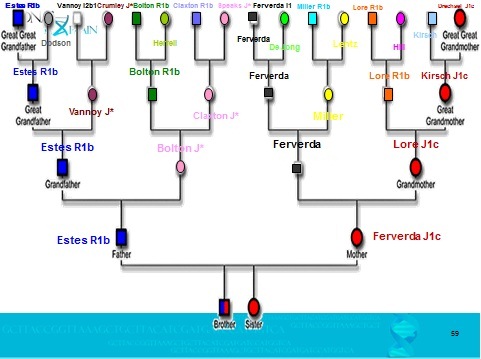
You tin can run into the Y-line of my father and the mitochondrial line of my female parent, on both ends of the full-blooded chart. At the summit of each line, I have recorded the haplogroup data for each family. Colour coding each line helps in tracking descendants who would comport the DNA of the ancestor of that line. For example, my mother'south father'southward mother's line is the yellow Miller line. I need to discover a girl of my grandfather'due south sisters, or their children, or their girl'southward children, to test for that mitochondrial DNA line. Which reminds me, I demand to call my cousin. Family unit reunions, picnics and holidays are great for this type of thing. Sadly, and so are funerals.
I blogged about how to put together your own DNA pedigree nautical chart. If you're Native and adopted, and so refer to the adoptee weblog instead, or in addition.
Just sometimes, nosotros tin't notice the right people in order to test, so nosotros motility to autosomal testing to aid united states of america fill in the blanks.
Autosomal Testing – For Both Sexes – The Remainder of the Story
Autosomal Deoxyribonucleic acid testing tests all of your 23 pairs of chromosomes that you inherit from both of your parents. Yous go half of each chromosome from each parent. Y'all can meet this blueprint on the full-blooded chart, represented by all of the sixteen genealogical lines. Therefore, as you move up that tree, you should take inherited about 25% of your Deoxyribonucleic acid from each grandparent, well-nigh 12.5% of your Deoxyribonucleic acid from each smashing-grandparent, as have all of their other not bad-grandchildren.
Therefore beginning with your parents, you comport the following estimate amount of Deoxyribonucleic acid from each of these ancestors. I say approximate, because while you do receive exactly 50% of your DNA from each parent, at that place is no guarantee that their parents DNA was admixed in your parents such that yous receive exactly 25% from each grandparent, but it'due south close. You can see the percentages in the nautical chart below.
| Generation | Human relationship | % of Their DNA You Deport |
| one | Parents | 50 |
| 2 | Grandparents | 25 |
| 3 | Great-grandparents | 12.5 |
| four | GG-grandparents | half dozen.25 |
| v | GGG-grandparents | three.125 |
| half-dozen | GGGG-grandparents | ane.56 |
| seven | GGGGG-Grandparents | 0.78 |
Given this chart, if the Native per centum is back beyond 6 generations and drops below the 1% threshold, it's extremely difficult to discern today.
Autosomal testing will pick upwardly relationships reliably back to about the half-dozenth or 7th generations, and sporadically across that.
Autosomal testing provides you minimally with two things. First, with a list of "cousin matches" by percentage and estimated human relationship. Second, percentages of ethnicity. It's this second part that's well-nigh important for the person seeking to bear witness Native American heritage.
Percentages of Ethnicity
As the field of genetic genealogy has moved forward, enquiry has begun to indicate that certain autosomal markers are plant in college or lower frequencies in unlike ethnic populations.
For example, if someone has the Duffy Null allele, or genetic marker, we know they positively have African admixture. Nosotros don't know how much African admixture, or from which line, or when that private with African admixture entered their family tree, but we know for sure they existed.
Attempting to make up one's mind the population frequency of varying markers and what that means relative to other populations is the primal to this analysis. Few markers are simply present or absent in populations, merely are plant in varying frequencies. Some populations are widely studied in the research literature, and others are virtually untouched. Thousands have only been recently discovered as part of the National Geographic, Genographic project.
The process of compiling this information in a meaningful manner and then that information technology can be analyzed is a formidable chore, as the information is oftentimes found in nearly inaccessible academic and forensic research publications. It'due south difficult to decide sometimes if the DNA analysis of 29 individuals in a small village in northern Italian republic is, for example, representative of that village as a whole, of northern Italy, or more broadly for all of Italy. Is it representative of Italy today or Italy historically? These and other similar questions have to exist answered fully earlier the data from autosomal testing tin can exist useful and reliable.
Let's take a look at all 3 of the contemporary autosomal tests and what they have to offer.
Notation: as of 2019, MyHeritage is also a major player in the autosomal DNA testing infinite.
Family Tree DNA
Family unit Tree DNA sells the Family Finder examination. Right now it is priced at $79 or arranged with bonny pricing with either the Y-line or mitochondrial Dna tests. I often like to employ this tool in conjunction with the Y-line and mitochondrial Dna tests to run across, if you match someone closely, whether y'all are actually related to them in a contempo timeframe or if it is further back. Family Tree DNA is the only one of the autosomal testing companies that has the ability to do this type of advanced comparing. Compared to 23andMe and Geno 2.0, they are the just ones to offer traditional Y-line and mitochondrial Deoxyribonucleic acid testing which provides private marker results and matches.
In improver to a list of autosomal matches, you will receive your breakup of ethnicity, by percent. The results below are for the same man with Native ancestry whose Geno 2.0 results are shown in the Geno 2.0 – First Peek weblog.

You tin read more about the Family Tree Dna autosomal product on their FAQ.
23andMe
Another company that sells autosomal testing is http://www.23andme.com. In addition to a list of cousins, y'all as well receive admixture percentages, and their specialty, health traits. Yous also receive a paternal and maternal haplogroup, merely with no markers for personal comparison. These Y-line and mitochondrial results are not as accurate at the Geno 2.0 nor the Family Tree DNA Y-line and mitochondrial DNA full sequence tests.
Be aware that while people who exam at Family Tree Dna are interested in genealogy, the typical person at 23andMe tested for the health portion, not the genealogy portion, and may not answer contact requests or may know very little about their family history.
Right now, their exam is $99, and you tin download your results and upload them to Family unit Tree DNA for an additional $89, making the full price similar to the Family Tree Deoxyribonucleic acid test. However, y'all need to be somewhat technically savvy to complete the download/upload process.
23andMe recently released a new version of their software which added quite a scrap of resolution after years of being woefully behind. Native American wasn't even a category previously.
Beginnings
Beginnings.com recently introduced an autosomal exam. You receive matches and ethnicity percentages. Notwithstanding, their ethnicity percentages have significant issues and I would non recommend them at this time. Their cousin matches come with no assay tools. So for now, just skip Ancestry and concentrate on the other resources.
One Concluding Autosomal Exam
One marker value in item, known as D9S919 is present in about 30% of the Native people. The value of 9 at this marker is not known to be present in any other indigenous group, so this mutation occurred after the Native people migrated beyond Beringia into the Americas, only long enough agone to be nowadays in many descendants. You can examination this marker individually at Family Tree Deoxyribonucleic acid, which is the simply lab that offers this test. If you take the value of nine at this marker, it confirms Native heritage, but if you don't carry 9, it does Not disprove Native heritage. After all, many Native people don't carry it.
To order this test, for existing Family Tree DNA clients, click on the "Guild Upgrade" orange push button on the right hand side of your personal page, so on "Advanced Examination", then enter "autosomal" in the drop down box, and then you will see the list below. D9S919 is the last i and it costs $xv. There may be a $x in one case transfer fee too if your DNA sample is not in the Houston lab.

Pond in Many Pools
As you tin can see at that place are lots of tools bachelor to you that can be used individually or in conjunction with each other. Similar anything else, the more than piece of work and endeavor you are willing to devote to the search, the more probable you are to exist successful.
Almost people test their Y-line and mitochondrial DNA, not simply for Native beginnings, but to larn more about the lines they can test for themselves without reaching out to other family members.
Utilise your Deoxyribonucleic acid full-blooded nautical chart to plan who to ask in your extended family unit to test for which lines.
Plan to test with multiple autosomal testing companies. Autosomal testing in particular is nevertheless in its infancy. I like to use the results of multiple companies, especially when you lot are dealing with small amounts of admixture. They utilise dissimilar markers, combinations, analysis tools and reference populations, so you lot tin can wait slightly different results. I company may pick upward slight minority admixture while another may not. This has happened repeatedly with both my Native and African minority admixture.
GedMatch
After you obtain your results from either Family Tree Deoxyribonucleic acid or 23andMe, you'll want to download your raw information results and and then upload the file to www.gedmatch.com. This is a privately run "donation" site, non associated with any of the testing companies, pregnant there is no subscription or fee to use the tools, but they do capeesh and are funded by donations.
After uploading your results y'all tin utilize several admixture tools to compare and contrast your results.
Getting Help
If you're struggling with working through your family unit possibilities for who to exam, I do offering a DNA Exam Program service.
If you would similar a Personalized Deoxyribonucleic acid Report for Y-line or mitochondrial results, those are available also.
If you accept what amounts to a quick question that I can respond in less than an hour, including prep, I offer the Quick Consult service.
For more extensive consulting, contact me. You can meet my services here.
In Summary
Finding our Native ancestors is a mode to pay homage to their lives and to the culture that was stripped from their descendants, ironically, by using their own Dna that has been gifted from them to u.s.. Native people, afterward contact with Europeans were marginalized, and that's the best that can be said. Many were killed, either intentionally or past European diseases, or enslaved. The results are that Native people left few if whatsoever individual records and those that might exist available often can't be identified or linked to them personally. For those who cannot unearth their Native beginnings using conventional genealogical means, genetic testing is the last hope left. Fortunately, the tools and our noesis improve every day. We're making bang-up strides with what we tin can practice, enlarging what was a pinhole into a keyhole, allowing us to peer into the past. And so, click your heels, order your tests and let's see where your Dna takes you.
______________________________________________________________
Disclosure
I receive a small contribution when you lot click on some of the links to vendors in my articles. This does Not increase the price y'all pay just helps me to keep the lights on and this informational blog free for everyone. Delight click on the links in the articles or to the vendors below if y'all are purchasing products or Dna testing.
Cheers so much.
Dna Purchases and Free Transfers
- Family Tree Deoxyribonucleic acid
- MyHeritage Dna only
- MyHeritage DNA plus Wellness
- MyHeritage FREE Deoxyribonucleic acid file upload
- AncestryDNA
- 23andMe Beginnings
- 23andMe Ancestry Plus Wellness
- LivingDNA
Genealogy Services
- MyHeritage Complimentary Tree Builder
- MyHeritage Subscription with Free Trial
Genealogy Research
- Legacy Tree Genealogists for genealogy research
Source: https://dna-explained.com/2012/12/18/proving-native-american-ancestry-using-dna/
0 Response to "what percentage of native american to be considered native american"
Post a Comment