What Is Normal Glucose Reading After Fasting
What should your glucose levels be? Here's the ultimate guide to salubrious claret saccharide ranges
It'due south hard to observe data about what glucose levels to strive for. We scoured the research literature to make up one's mind "what'due south normal" for a nondiabetic private wearing a continuous glucose monitor, and give farther insights into what glucose levels might exist optimal for good health.

Article highlights
- This commodity reviews the standard clinical criteria for normal glucose levels.
- Given the growing use of continuous glucose monitors (CGM) in research studies, we requite an overview of data on glucose patterns in nondiabetic individuals wearing CGM.
- Standard tests to assess glucose levels include fasting glucose examination, three month average glucose levels exam (hemoglobin a1c), and an oral glucose tolerance test. These data points are momentary snapshots, and exercise not requite insight into what is happening to an individual'due south highly dynamic glucose level over fourth dimension and whether these trends are healthy.
- CGM goes further by showing continuous data well-nigh daily glucose trends, simply there is no clinical consensus however on goal 24-hour glucose levels for a nondiabetic individual.
- Our analysis of the research literature distills insights about what may be safe and optimal ranges to strive for throughout a 24-hour bicycle for a healthy, nondiabetic individual, and propose a series of glucose ranges that can be helpful to orient around when determining what to strive for on a day-to-twenty-four hours footing while using CGM.
- Based on the information of healthy individuals wearing CGM, information technology appears that it is safety and healthy to strive for a fasting glucose between 72-85 mg/dL, a post-meal glucose level 110 mg/dL or lower, and an average glucose of 100 mg/dL or lower.
[Click below to heed to an sound version of this story.]
What's considered a "normal" glucose level?
Your medico will likely test your blood glucose levels equally a screening examination for diabetes during a standard yearly check-up. Additionally, many people rails their glucose at habitation with an over-the-counter finger-prick examination. When you lot check blood glucose (also called claret sugar), either at a dr.'s office or with a home finger stick glucose monitor, the results are in milligrams (mg) of glucose per deciliter (dL) of blood. (Note that in many countries, the standard measurement is mmol/L; to convert the values beneath to mmol/L, divide the mg/dL by xviii.)
One of the most common glucose measurements is fasting plasma glucose (FPG) or fasting claret glucose (FBG), and it's plant by checking blood glucose levels after not having whatsoever calories at least eight hours earlier the test. According to the American Diabetes Association (ADA), people can be classified into 3 categories depending on their fasting plasma glucose levels: normal, prediabetes, and diabetes. To be considered "normal," fasting glucose must exist under 100 mg/dl.
Post-repast glucose levels are also meaningful, and high mail-meal glucose levels can worsen glucose control over fourth dimension and lead to obesity, diabetes, cardiovascular illness, and dumb exercise and cognitive performance. While it is not unexpected for glucose levels to increment afterward a meal equally the glucose from the meal is released into the blood, if this level is too loftier, it is non good for health and tin can predispose one to disease over time. According to the International Diabetes Federation (IDF) guidelines for managing post-meal glucose levels, nondiabetic people should accept a glucose level of no higher than 140 mg/dl later on meals, and glucose should return to pre-meal levels inside 2-3 hours. Post-meal hyperglycemia (elevated glucose) is defined as a glucose level >140 mg/dl 1-two hours after the ingestion of food or drinks.
These glucose measurement methods mentioned and so far rely on a single point-in-time measurement to determine if your levels are normal. Recent advances in continuous glucose monitoring (CGM) applied science let you lot to track your glucose levels over a 24-hour menstruation and gain insight into deeper trends associated with health, such as glycemic variability, a measure of the up-and-down swings in glucose throughout the day. Nevertheless, there are no standardized, universally accepted criteria for what "normal" 24-hour glucose values are using CGM technology. Scientists are continuing to assemble information about glucose levels in healthy people using CGM technology.
Of note, CGM devices measure interstitial glucose levels (glucose from the fluid in between cells) compared to blood/plasma glucose levels (glucose in the blood) measured in the FPG tests. While interstitial glucose and blood/plasma glucose levels correlate highly, they are not precisely the same, and diagnoses are not made from interstitial measurements.
Below is a summary overview of data about 24-hour glucose trends in nondiabetic individuals wearing CGM to gain a meliorate understanding of "what's normal."
CGM Studies In Nondiabetic Individuals
One written report from 2009 entitled "Reference Values for Continuous Glucose Monitoring in Chinese Subjects" looked at the glucose levels of 434 good for you (nondiabetic, non-obese) adults using CGM and found the following:
- On average, their daily glucose levels stayed between 70–140 mg/dl for 93% of the 24-hour interval, with very small portions of the day spent above 140 mg/dl or below 70 mg/dl.
- Too, their hateful 24-hour glucose levels were effectually 104 mg/dl (± ten mg/dl)
- 1-hour post-meal glucose values boilerplate 121-123 mg/dl for breakfast, lunch, and dinner
- 3-hour mail service-meal glucose values were effectually 97-114 mg/dl.
- Peak post-repast values appeared to be around sixty minutes after eating.
- Mean fasting glucose was 86 ± 7 mg/dl.
- Hateful daytime glucose was 106 ± 11 mg/dl.
- Mean nighttime glucose was 99 ± 11 mg/dl.
A 2010 study, "Variation of Interstitial Glucose Measurements Assessed past Continuous Glucose Monitors in Good for you, Nondiabetic Individuals," looked at a healthy population of 74 individuals that included children, adolescents, and adults during daily living using CGM. This enquiry showed that:
- Glucose levels stayed between 71-120 mg/dl for 91% of the day.
- Levels were lower than 70 mg/dl for 1.7% of the time and greater than 140 mg/dl, only 0.4% of the fourth dimension.
- Mean 24-60 minutes glucose was 98 ± 10 mg/dl.
- Mean fasting glucose of 86 ± viii mg/dl.
Compared to the offset study mentioned, these salubrious, nondiabetic individuals appeared to accept a tighter range of glucose, spending the vast majority of the 24-hr menstruum between 71-120 mg/dl.
A 3rd study, from 2008, entitled "Characterizing Glucose Exposure for Individuals with Normal Glucose Tolerance Using Continuous Glucose Monitoring and Ambulatory Glucose Profile Analysis," looked at 32 individuals with normal glucose tolerance wearing CGM for approximately 29 days and showed the following findings:
- Among all participants, 24-hour glucose boilerplate ranged from 94 mg/dl to 117 mg/dl
- Overall hateful glucose level was 102 +/- vii mg/dl
- Mean daytime glucose was 105 ± 8 mg/dl
- Mean nighttime glucose was 97 ± half dozen mg/dl
- Participants spent 93% of time between glucose values of 70-140 mg/dl, with 3% of the time beneath 70 mg/dL on boilerplate and iv% of the fourth dimension in a higher place 140 mg/dl on average
- Looking at individuals in the study, some spent as fiddling as .3% of the time (four minutes per 24 hours) at values > 140 mg/dl
- Some healthy individuals in the study spent approximately 2.8 hours per 24 hours at glucose values <lxx mg/dl, and an hour < 60 mg/dl
A 4th study, "Continuous Glucose Monitoring Profiles in Healthy Nondiabetic Participants: A Multicenter Prospective Study," from 2019, examined 153 healthy, nondiabetic children and adults ages 7-80 with normal mean BMI of 24 ± iii.2 kg/m2 wearing CGM for upwards to 10 days. This written report showed:
- Mean glucose levels of 99 ± 7 mg/dl
- Standard deviation of glucose levels of 17 ± 3 mg/dl
- Cipher glucose readings >180 mg/dL
- 89% of glucose sensor values fell between 70-120 mg/dl
- 96% of glucose sensor values barbarous betwixt 70-140 mg/dl
- 2.1% of glucose sensor values were >140 mg/dl
- one.3% of glucose sensor values were <70 mg/dl
A 2007 study, "Continuous Glucose Profiles in Good for you Subjects nether Everyday Life Conditions and after Different Meals," looked at 21 salubrious young individuals using CGM. These participants were between historic period 18-35, had a healthy BMI of 22.vi ± 1.7 kg/m2, and were examined eating standardized meals also as regular meals of their choosing. Hateful fasting glucose for these participants was 80 mg/dl. This written report found:
Under everyday life conditions:
- Mean 24-hour glucose concentration was 89.3 ± 6.2 mg/dL (range 79.2-101.3 mg/dL)
- Mean daytime glucose was 93 ± seven.0 mg/dl
- Mean nighttime glucose was 81.8 ± 6.3 mg/dl
- Participants spent ~80% of the time between glucose values 59-100 mg/dL, and only 20% of the fourth dimension between 100-140 mg/dl
- Glucose was to a higher place 140 mg/dL for only 0.8% of the day
- Hateful pre-repast glucose levels were 79.4 ± 8.0 to 82.one ± 7.ix mg/dl
- Mean time to post-repast glucose superlative was betwixt 46 and 50 minutes
- Mean summit postal service-meal glucose levels of 132 ± sixteen.7 mg/dl at breakfast, 118 ± 13.4 mg/dl at tiffin, and 123 ± 16.nine at dinner
Under standardized meal conditions with a moderately low percentage carbohydrate (50 grams, 26.viii%), high cobweb (12.8g), high-fat meal (47 grams, 56.seven% fat), and high protein (30.9 grams, xvi.5%), participants displayed:
- Mean peak post-repast glucose levels of 99.two ± 10.5 mg/dl
- Mean mail service-meal modify from baseline of twenty.ii ± 7.2 mg/dl
- Mean time to summit was 57.5 ± 24.five minutes
Finally, the 2018 paper, "Continuous glucose monitoring is more sensitive than HbA1c and fasting glucose in detecting dysglycaemia in a Spanish population without diabetes," assessed 254 people with normal glycemic function wearing CGM for 2-five days. The hateful BMI of these participants was overweight, at 27.3 ± 4.7 kg/m2. Their results plant:
- Means fasting glucose of 84.six ± 7.2 mg/dl
- Mean 24-60 minutes glucose was 104.4 mg/dl
- Hateful daytime glucose was 106.ii mg/dl
- Hateful nighttime glucose was 102.half dozen mg/dl
- Participants spent 97% of the fourth dimension between lxx-140 mg/dl
- Participants spent 1.half dozen% of the time above 140 mg/dl
- 9.seven% of participants had post-repast (breakfast and luncheon) glucose levels that reached >140 mg/dl
- 12.1% of participants had mail service-meal (dinner) glucose levels that reached >140 mg/dl
Summary Of Normal Glucose Ranges
In summary, based on ADA criteria, the IDF guidelines, a person's glucose values are "normal" if they accept fasting glucose <100 mg/dl and a post-meal glucose level <140 mg/dl. Taking into business relationship additional research performed specifically using continuous glucose monitors, we can gain some more clarity on normal trends and tin suggest that a nondiabetic, healthy individual can expect:
- Fasting glucose levels between fourscore-86 mg/dl
- Glucose levels between 70-120 mg/dl for approximately 90% of the mean solar day (and to rarely ever go above 140 mg/dl or below 60 mg/dl)
- 24-hour mean glucose levels of around 89-104 mg/dl
- Mean daytime glucose of 83-106 mg/dl
- Mean dark glucose of 81-102 mg/dl
- Mean post-meal glucose peaks ranging from 99.2 ± 10.v to 137.two ± 21.1 mg/dl
- Time to post-meal glucose peak is effectually 46 minutes – one hour
These are not standardized criteria or ranges only can serve as a simple guide for what has been observed as normal in nondiabetic individuals.
Beyond "normal" goals: What'southward an "optimal" glucose level, and why does it affair?
Exact numbers for what is considered "optimal" glucose levels to strive for while using CGM to accomplish your all-time wellness are non definitively established; this is a question that is individual-specific and should exist discussed with your healthcare provider. With that said, research shows that there is an increased risk of health problems every bit fasting glucose increases, fifty-fifty if it stays inside the "normal" range, making finding your "optimal" glucose levels all the more than important.
While the International Diabetes Federation and other enquiry studies have shown that a post-meal glucose spike should be less than 140 mg/dL in a nondiabetic individual, this does non determine what value for a post-repast glucose elevation is truly optimal for your health. All that number tells united states is that in nondiabetics doing an oral glucose tolerance test, researchers found that these individuals rarely go above a glucose value of 140 mg/dL after meals.
So, while this number may represent a proposed upper limit of what's "normal," it may not betoken what volition serve you best from a wellness perspective. Many people may likely do better at lower post-meal glucose levels. Similarly, while the ADA states that a fasting glucose less than 100 mg/dL is normal, information technology does not signal what value is optimal for wellness.
Lastly, in that location are no specific recommendations regarding the average glucose levels over a 24-hour menses using CGMs. This lack of standardization is likely because CGMs are relatively new and not widely used in a non-diabetic population.
The following is a summary of insights from our review of inquiry. You should consult with your md before setting whatever glucose targets or irresolute dietary and lifestyle habits.
Levels Proposed Optimal Glucose Values
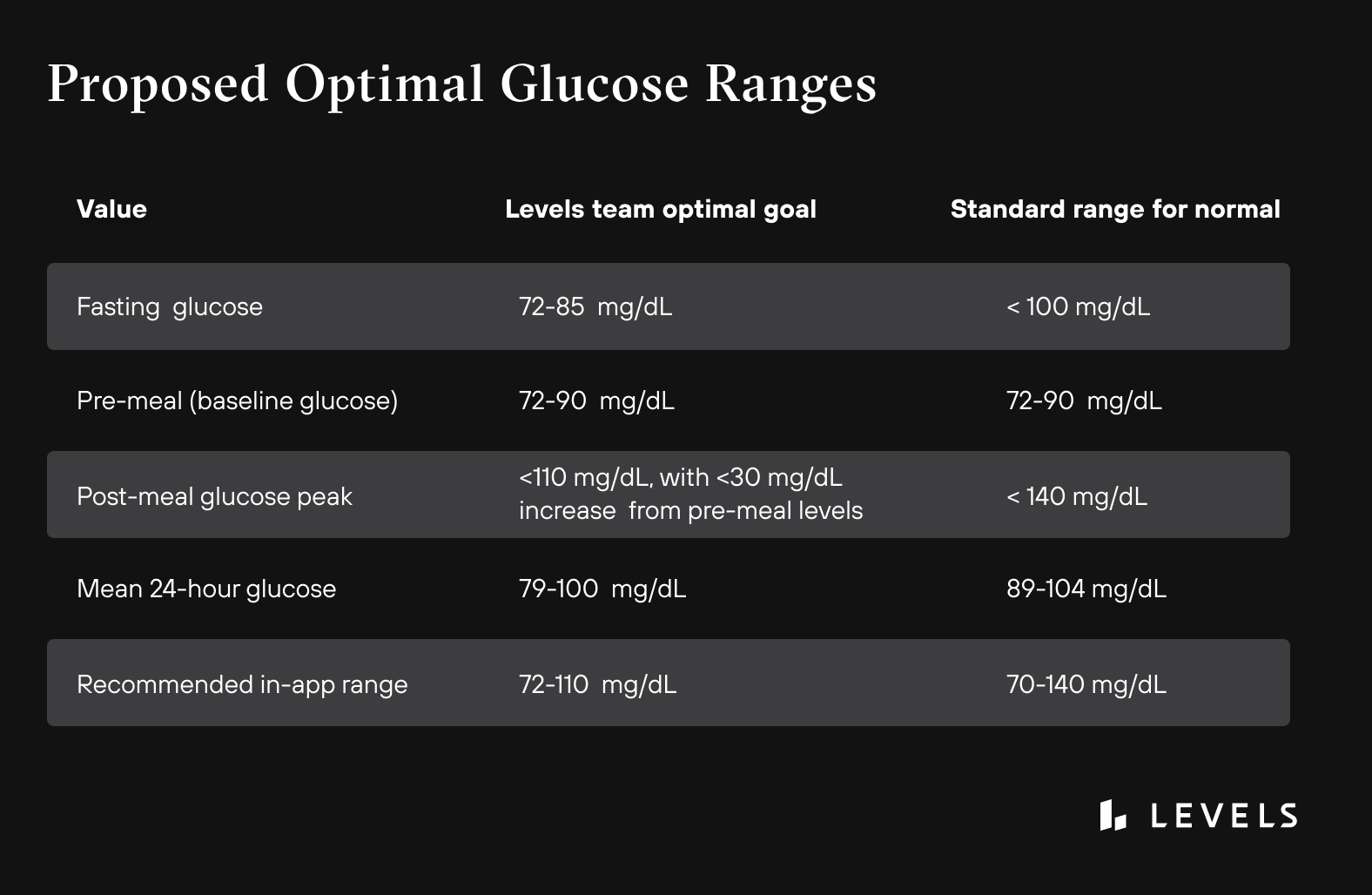
Fasting Glucose Goal: 72-85 Mg/dL
Why? Previously nosotros discussed that the ADA considers normal fasting glucose equally anything <100 mg/dl. However, multiple inquiry studies show that as fasting glucose increases, there is an increased risk of health problems like diabetes and centre disease — fifty-fifty if information technology stays within the normal range. The highlights of some of the study results include:
- Men whose fasting blood glucose was greater than 85 mg/dl had a significantly higher bloodshed rate from cardiovascular diseases than men with blood sugars less than 85 mg/dl. (Bjornholt et al.)
- Children with fasting glucose levels 86-99 mg/dl had more than double the risk of developing prediabetes and Blazon 2 diabetes as adults when compared with children whose levels were less than 86 mg/dl. (Nguyen et al.)
- People with fasting glucose levels betwixt 91-99 mg/dl had a 3-fold increase in Type 2 diabetes run a risk compared to those with levels less than 83 mg/dl. (Brambilla et al.)
- Among young, healthy men, higher fasting plasma glucose levels within the normal range constitute an independent risk factor for Type 2 diabetes. This ways that as fasting glucose increases, even if the level is yet considered "normal," information technology could indicate a significantly college risk of developing diabetes, and this is specially pronounced if BMI is greater than 30. (Tirosh, et al.).
Pre-Repast (Baseline) Glucose Goal: 72-90 mg/dL
Why? In a study looking at healthy, immature, nondiabetic adults who had normal BMI (mean of 22.half dozen ± 1.seven kg/m2), the average pre-meal glucose levels were in the range of 72-ninety mg/dl.
Mail service-Repast Glucose Goal: Less Than 110 mg/dL, With No More than A 30 mg/dL Increase From Pre-Meal Levels
Why? In a study looking at good for you nondiabetic adults, researchers establish that the average post-repast glucose tiptop was 99 ± x.5 mg/dL after a standardized balanced meal. In contrast, meals with less fiber and more refined sugars caused a higher post-meal glucose spike (up to an boilerplate of 133 ± 14 mg/dl) in the same population. Some other study besides looking at healthy, nondiabetic adults establish an average mail service-repast spike of approximately 122 ± 23 mg/dl. Taking the standard difference of these averages into consideration, aiming for a post-repast glucose level of less than 110 mg/dl with no more than a 30 mg/dl increase from pre-meal levels is a reasonable goal to strive for.
Mean 24-Hr Glucose Goal: 79-100 mg/dL
Why? These numbers stand for the mean 24-60 minutes glucose range in a young, very good for you population. We looked at several unlike studies of nondiabetic populations wearing CGMs, and this was one of the overall healthiest populations under normal living weather condition. Therefore we recollect that 79-100 mg/dl is a safe and healthy range to orient towards.
Retrieve, your "optimal" glucose levels are specific to you, and you should talk with your healthcare provider near your glucose goals.
How can continuous glucose monitoring (CGM) assist you maintain optimal glucose levels?
It is not uncommon for your glucose levels to increase after a repast: you just ate food that may contain glucose, and now your body is working on getting it out of the bloodstream and into the cells. Nosotros know that we want to prevent excessive spiking of glucose levels considering studies show that high mail-repast glucose spikes over 160 mg/dl are associated with college cancer rates. Spikes are also associated with heart illness. Repeated high glucose spikes subsequently meals contribute to inflammation, blood vessel damage, increased risk of diabetes, and weight gain. Additionally, the data shows that the big spikes and dips in glucose are more than damaging to tissues than elevated but stable glucose levels. Therefore, you should strive to keep your glucose levels as steady every bit possible, at a low and healthy baseline level, with minimal variability later on meals.
Keeping your glucose levels constant is more than complicated than but post-obit a list of "eat this, avoid that" foods. Each person has an private response to food when it comes to their glucose levels; studies have shown that two people tin take different changes in their glucose levels after eating identical foods. The difference can be quite dramatic. One report found that some people had equal and opposite mail service-meal glucose spikes in response to the same nutrient.
So how do you keep your glucose levels stable? How do you know when you have a carbohydrate fasten and which foods caused it? That's where CGM comes into play. Continuous glucose monitoring allows you to see your blood glucose levels in existent-time and store that information for hereafter reference; this makes CGMs uniquely positioned to aid yous optimize your nutrition and lifestyle. Foods affect each person differently, and it is hard to know what your claret glucose is doing at any one fourth dimension without measuring it. CGMs tin give you the data you need to optimize your health. Choosing foods and lifestyle habits that consistently go on average glucose lower and mail service-meal spikes lower will improve glucose patterns over fourth dimension.
Studies take shown that the information gathered from CGMs tin can provide more than detail and more than potential areas for modification than the single glucose level that you lot become with a glucometer or laboratory claret test. One report looked at sub-elite athletes and found that iv out of x study participants spent more than than 70% of the total monitoring time above salubrious glucose levels, and 3 of 10 participants had fasting glucose in the prediabetic range.
Similar results have been institute in other studies: one reported that 73% of the "healthy" nondiabetic participants had glucose levels that were above normal in the range of 140-200 mg/dl at some betoken during the day.
CGMs can not only give you data on your claret glucose, simply they can aid you employ the data to brand changes to your diet and practise routines. Studies have shown that continuous glucose monitoring can characterize an individual's glucose response to specific foods and, in plow, predict their responses to other foods. This technology can allow individuals to create personalized meal plans that suit their unique metabolic needs and better glucose control.
What are abnormal glucose levels, and why do they thing?
Why is information technology unhealthy for glucose levels to be too high (hyperglycemia) or also low (hypoglycemia)?
Hyperglycemia refers to elevated claret glucose levels. This commonly occurs considering the body does non appropriately remove glucose from the blood; this can happen due to many complex reasons. Elevated glucose levels can damage blood vessels and nerves over time; this can so atomic number 82 to problems in the eyes, kidneys, and eye, besides as numbness in the easily and feet. Very high levels tin lead to coma and even expiry in some cases. People with fasting glucose levels higher than 100 mg/dl have impaired glucose tolerance and should speak with their healthcare provider.
Some people may recall that to avoid all these issues, they should just proceed their blood glucose levels as low as possible. If likewise loftier is bad, then low must be good, right? Not exactly. When glucose gets too low, it'due south chosen hypoglycemia. The threshold for hypoglycemia is typically thought to be when glucose falls below 70 mg/dl. When this happens, the body may release epinephrine (adrenaline), the "fight or flight" hormone, which can atomic number 82 to a fast heart rate, sweating, anxiety, blurry vision, and defoliation, just as well helps the body mobilize glucose into the blood. If claret glucose levels stay too low for too long, it tin crusade seizures, coma, and in very rare instances, expiry.
The Nuances Of Low Glucose
In a recent written report, researchers reviewed the published literature to see if low fasting glucose levels affected healthy people's long term risks of health problems, like strokes and middle attacks. They establish that healthy not-diabetic people who had baseline fasting glucose levels of less than 72 mg/dl had a 56% increase in all-cause mortality compared to people with normal fasting blood glucose levels. As well, the risks for heart attacks and strokes were college in people with baseline fasting glucose levels less than 72 mg/dl. This consequence is likely due to the body releasing more than epinephrine to counteract the low glucose levels; also much epinephrine for also long leads to heart bug. Interestingly, people with low fasting glucose levels of less than 83 mg/dl merely college than 72 mg/dl did not have an increased run a risk of future eye attacks and strokes.
While there has been an association between low fasting plasma glucose levels and worse health outcomes, it is not clear whether transient dips in glucose levels (less than seventy mg/dL) during a continuous 24-60 minutes period are unhealthy for nondiabetic individuals. Part of the reason that this is unknown is that continuous glucose monitoring is a relatively new engineering science and has been studied more extensively in diabetic individuals than in good for you individuals.
Long-term wellness outcomes relating to 24-hour glucose profile metrics are still being evaluated. In ane study looking at non-diabetic, healthy individuals wearing CGMs over a 24-hour period, data showed that glucose dips below seventy mg/dL really occur quite frequently. In fact, 41% of these healthy individuals experienced glucose levels less than 70 mg/dL in a 24-hr period, and the men'south levels were below 70 mg/dl for 2.7 +/- 6.1% of the 24-hour period (two.1 +/- 4.4 % in women). Based on this data, healthy individuals can reasonably spend an average of 39 minutes with glucose values less than seventy mg/dL (in men). Furthermore, considering i standard deviation higher than the average, it could reasonably exist considered "normal" to spend up to 126 minutes (8.8% of a 24-hour catamenia) with CGM-measured glucose values less than 70 mg/dl. The clinical significance of these low glucose levels is unknown. Still, research suggests that many healthy individuals wearing CGMs spend some amount of time with glucose levels less than lxx mg/dL.
Research likewise shows that glucose levels decrease by an boilerplate of five% during REM sleep compared to non-REM sleep stages, which may contribute to periodic dips seen at dark in nondiabetic people. In fact, healthy people who have glucose dips beneath 70 mg/dl have twice every bit many dips at night as compared to during the 24-hour interval. Additionally, pressure on the CGM sensor from laying on it can cause abnormal low values.
Lastly, glucose dips below 70 mg/dL that occur just after a postal service-meal glucose spike may indicate reactive hypoglycemia; which is an exaggerated insulin response to a loftier saccharide meal, causing an overshoot in the amount of glucose that is absorbed out of the bloodstream and into cells and is non good for health. Once again, we don't want high highs and depression lows; stable glucose appears to be amend for the body. These glucose dips are typically characterized past symptoms including fatigue and lack of free energy. They can be avoided by a low-carbohydrate/low-glycemic eating design with reduced mail service-meal glucose spikes.
Even though at that place is no defined depression indicate for nondiabetic fasting blood glucose levels, keeping your blood glucose levels higher up a minimum threshold of 72 mg/dl may be beneficial for healthy, non-diabetic people.
Conclusion
What does all this hateful? It ways that while in that location are well-established "normal" ranges of fasting and post-meal glucose levels, these don't give clarity into what glucose trends should exist throughout a 24-hour menstruation. They also don't specify what ranges are optimal for the best wellness.
Even people with "normal" glucose levels may be at higher risk of health bug than they realize because of frequent glucose spikes and dips or elevated fasting glucose, fifty-fifty if in the normal range. Your optimal glucose levels depend on many individual factors, and setting those ranges should include a give-and-take with your healthcare provider.
The studies evidence that keeping your blood glucose in the normal range is important, but as well that preventing too many spikes and dips are key to maintaining your health. A personalized dietary and lifestyle plan that promotes metabolic health should also achieve three main goals:
- Minimize post-meal increases in glucose levels
- Keep glucose levels equally stable as possible and minimize swings in glucose throughout the day
- Endeavor to proceed fasting glucose in the depression finish of the "normal" range
Figuring out which nutrition and lifestyle choices will allow yous to attain these goals is an iterative process; no one-size-fits-all plan works for everyone to keep claret glucose in their optimal range. Continuous glucose monitoring can help you establish your optimal diet and lifestyle choices by serving as a continuous feedback mechanism, closing the loop between specific actions and the torso'due south reaction, and paving the way for improved current and time to come wellness.
Source: https://www.levelshealth.com/blog/what-should-my-glucose-levels-be-ultimate-guide
0 Response to "What Is Normal Glucose Reading After Fasting"
Post a Comment