How Do You Know if You Have a Broken Metacarpal?
Metacarpal Fracture
Past Scott Kaar, M.D.
A metacarpal fracture or broken metacarpal is a fracture (break) of the tubular bones within the palm (metacarpals). They classically occur in the minor finger or metacarpal bone in boxers or athletes of other sports or activities. This type of fracture has therefore become to be known as a "boxer'southward fracture." Each of the digits of the hand has a corresponding metacarpal bone associated with it, and any of these metacarpals may be fractured during a high energy affect to an athlete's hand.
These injuries are also common in other sports besides battle. For case Ronnie Brownish of the Miami Dolphins and Tony Romo of the Dallas Cowboys each spent time on the IR from suffering a metacarpal fracture as did the Mavericks Jason Terry who had surgery to fix his metacarpal fracture.
Anatomy of Metacarpal
The metacarpals are the tubular bones that contain about of the space in the palm. Each of the fingers (digits) has a corresponding metacarpal that links the wrist basic to the phalanges (individual bones of the fingers). 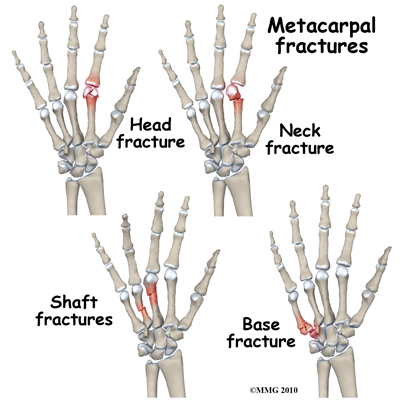 In that location are flexor tendons on the palm side of the metacarpals that deed to flex, or bend the fingers as in making a fist. There are extensor tendons on the back of the hand that act to extend or straighten the fingers. In between the metacarpal bones are the small-scale intrinsic muscles (the interosseous and lumbrical muscles) that farther help to control fine finger motility. When a metacarpal fracture happens, the finger flexors and the intrinsic muscles act together to bend the fracture toward the palm (apex dorsal angulation). How much the fracture bends is somewhat dependant on how much force acquired the injury in the kickoff place. A higher strength injury can lead to more bending (deportation of the fracture).
In an athlete's normal uninjured hand, at that place is less motion at the joints of the index and long finger and more than movement at the band and small fingers. The increased motion at the two smaller fingers allows for more than angulation to exist acceptable as the fracture heals. This is because the increased normal motion of these two metacarpal bones can allow the mitt to adapt to any permanent deformity. On the other hand, the index and long fingers' have bottom power to adapt to metacarpal fracture bending considering they accept less natural motion. The normal motion of the metacarpals tin can exist seen when one makes a tight fist while watching the ring and small finger side of the back of the manus bend further inward.
Metacarpal Fracture Symptoms
An injured athlete volition describe a forceful blow to the mitt. It will often be due to a punching injury or a straight blow from a fall or crush injury. Their hand will be very painful, maximally so over the specific metacarpal bone that is fractured. There will exist swelling, often a considerable amount, as well as bruising directly over the injury. They may have difficulty moving the fingers due to the amount of pain from the fracture.
On concrete examination, the athlete's hand will be near tender over the injured metacarpal. At that place may exist palpable fracture ends of the bone which can be felt to move if pressed. If the fracture becomes angled, so the manus may be bent inward towards the palm some and in that location may be a point felt from the apex of the fracture. One important aspect of the concrete examination is whether there is a rotational deformity of the fracture. This can be assessed by request the patient to make a fist. When they do then, the fingers should all line upwards properly and be parallel. If the finger respective to the fractured metacarpal does not line up properly with the surrounding fingers, then the fracture ends are near probable rotated. When this happens, oft the injured finger will scissor nether or in a higher place an adjacent finger.
A metacarpal fracture can occur in any sport although the highest risk is in those sports where there is a chance of a high energy impact occurring to the athlete'due south manus. Classically this occurs in boxers and other athletes involved in the martial arts. However other impact sports like football and rugby place the competitor's easily at gamble of touch on against things like opposing players' helmets and pads as well every bit the ground itself.
Causes
A metacarpal fracture occurs when the mitt strikes another object with sufficient force to cause the metacarpal bones to break. This unremarkably occurs during a punch with a clenched fist. In doing so, the duke (the heads of the metacarpals) strike directly against a difficult object and all the force of the accident is transmitted direct through the metacarpals. This explains why boxers are susceptible to these fractures, especially when someone throws a punch without the protection of gloves. A crush injury to the hand can also crusade a metacarpal fracture such every bit if someone lands direct on the athlete'due south manus.
Metacarpal Fracture Treatment
Splint for metacarpal fracture
A gutter splint or cast should be used to immobilize a metacarpal fracture. A gutter splint may be modified based on the location of the injured finger. An ulnar gutter splint, also subsequently called a "boxer splint", should exist used for 4th or 5th metacarpal fractures leaving the thumb, index, and ring fingers complimentary. A radial gutter splint should be used for second or 3rd metacarpal fractures, with a hole for the thumb while leaving the band and pinkie gratis.
Initial treatment involves using a metacarpal fracture splint on the hand. In doing so, the hard splint does non circumferentially surround the hand and forearm, rather some of the circumference is only a soft wrap to let for swelling to occur. The fingertips will exist usually out of the splint and left complimentary to permit them some motion and to non get strong.
Subsequently treated
Later on a closer exam and radiographs are performed, the next determination is whether or not surgery is necessary. In the great bulk of cases, the fracture is lined up sufficiently and there is not as well much deformity of the bone ends. More than deformity can exist accepted in the ring and small finger without needing surgery considering these fingers have a greater compensatory capability because they take more than movement than the index and long fingers. Whatsoever significant scissoring is unacceptable to be treated airtight every bit this deformity is poorly tolerated even after the fracture heals.
If the metacarpal fracture is indeed lined up within an acceptable range, and then the patient's metacarpal fracture splint is changed to a difficult circumferential cast in many cases. In some cases where the fracture is not displaced (shifted) at all or very little, a removable splint tin can be considered, notwithstanding the athlete accepts a risk of the fracture bone ends shifting further particularly if the hand is impacted a second time. In well-nigh cases, the metacarpal fracture heals well and does so over the course of 6 to 8 weeks. Over that fourth dimension the cast tin be removed subsequently a period of time and changed to a removable splint. Ten-rays are checked every few weeks to exist sure the fracture is healing properly and the bone ends maintain their alignment.
When to See the Physician
Hundreds of athletes sustain acute injuries every day, which tin be treated safely at home using the P.R.I.C.East. principle. Simply if there are signs or symptoms of a serious injury, emergency get-go aid should be provided while keeping the athlete at-home and still until emergency service personnel get in. Signs of an emergency situation when you should seek care and doctor treatment can include:
- Os or joint that is conspicuously deformed or broken
- Astringent swelling and/or hurting,
- Unsteady breathing or pulse
- Disorientation or confusion
- Paralysis, tingling, or numbness
In add-on, an athlete should seek medical care if acute symptoms practise not go away later on balance and home handling using the P.R.I.C.E principle.
What imaging is necessary for a metacarpal fracture?
Definitive diagnosis of a metacarpal fracture requires a serial of hand radiographs to clearly evaluate the hand bones including the metacarpals. In certain cases where the fracture needs to be seen in greater item, a CT scan can exist considered, but this is highly unusual. Other imaging tests similar an MRI are almost never needed for an isolated metacarpal fracture as they normally don't add whatsoever further information beyond a regular x-ray. If other injuries are suspected, merely non seen clearly on the x-rays, then further tests could exist considered.
Is metacarpal fracture surgery needed?
Operative stabilization is necessary for metacarpal fractures where there is too much bending (angulation) or displacement at the fracture site. Usually around 15° is the maximum amount of angulation tolerated in the alphabetize and long finger metacarpals, while 35° is acceptable for the ring finger, and 50° is often tolerated in the small finger. Too, if scissoring is nowadays indicating unacceptable rotation of the fracture ends, and so fixation should be considered. Sometimes an attempt at realigning the fracture (closed reduction) is possible without an incision. If successful, the patient can be treated in a cast as outlined above.
Other less common reasons for surgery include a fracture where the overlying skin is broken and the wound communicates with the fractured bones (open fracture). In this case, surgery is often required to clean out the wound to subtract the take chances of an infection. In those injuries, the fractured metacarpal may be unstable because the soft tissue surrounding the bones is frequently worse injured and therefore provides less stability to the fracture. Lastly, in rare cases there may be a tendon laceration that occurs at the same time as the metacarpal fracture. In these injuries, the fracture is often fixed at the aforementioned time as the tendon is repaired.
Metacarpal fracture surgery
An injured athlete with a metacarpal fracture that requires operative stabilization is taken to the operating room and either sedated or placed nether general anesthesia to relax the patient and allow the fracture to exist manipulated. Sometimes the fracture ends can be realigned and pinned without a large incision. Many times notwithstanding an incision is needed and directly visualization of the fracture ends is achieved. The fracture is realigned (reduced) under direct visualization and then fixed in place with pins, screws or plates and screws (open reduction internal fixation). Then the fracture is immobilized for a period of time to protect the incision and the fracture.
Recovery time for metacarpal fracture
Following a metacarpal fracture treated operatively or not-operatively, the patient's hand and wrist are immobilized in a splint, cast or sometimes a removable splint as information technology heals. Radiographs are taken periodically to be certain that the fracture maintains its proper alignment and continues to heal. Metacarpal fractures usually take few months to heal, but the verbal timing of an athlete's return to their sport depends on how stable the fracture is and how much chance of re-displacing the fracture, the athlete, and treating physician feels comfortable with. In some sports, the athlete can train or compete even with a cast on such every bit running while others like pond are nigh impossible to participate in until a splint or bandage is no longer worn. Sometimes in collision sports like football, an athlete can compete with a protective removable splint while the fracture continues to heal although this is usually only possible for certain positions like lineman and defenders considering they don't rely equally much on property onto the ball.
Virtual Intendance from Sports Doctors and Specialists
 SportsMD offers Virtual Care and Second Stance Services. It allows y'all to speedily and conveniently speak with a sports doctor or specialist and have an effective culling to emergency room, urgent care, or waiting for a doctors appointment. You tin can get Virtual Care from your home or anywhere via phone or video chat.
Learn more here.
References
- Geissler WB. Operative fixation of metacarpal and phalangeal fractures in athletes. Hand Clin. 2009 Aug;25(3):409-21.
- Henry MH. Fractures of the proximal phalanx and metacarpals in the hand: preferred methods of stabilization. J Am Acad Orthop Surg. 2008 October;16(10):586-95.
- Singletary S, Freeland AE, Jarrett CA. Metacarpal fractures in athletes: treatment, rehabilitation, and safe early return to play. J Hand Ther. 2003 April-Jun;16(ii):171-9.
Source: https://www.sportsmd.com/sports-injuries/wrist-hand-injuries/metacarpal-fracture/
0 Response to "How Do You Know if You Have a Broken Metacarpal?"
Post a Comment